Commercial Septic Contract Terms: What Your Service Agreement Should Cover
If you run a restaurant, manage a few rental properties, or oversee an HOA in the Miami area, a septic service agreement is not just a convenience. It is your paper trail. When a county inspector asks for your grease trap cleaning records, or a buyer's attorney asks for a documented septic service history, the commercial septic contract terms you signed two years ago decide whether that conversation takes five minutes or five weeks. Understanding septic service agreement terms is critical for protecting your properties. This guide walks through what a solid agreement should cover, what vague language costs you later, and how to set up a contract that protects the whole portfolio instead of one tank at a time.
Why the Contract Matters More Than the Pump Truck
Most people shopping for septic pump out companies focus on the visit itself. Did the truck show up? Did they empty the tank? That matters, but for a business or a property manager, the visit is the easy part. Any competent local crew can pump a tank.
The harder question is what happens between visits. Who tracks when each property is due? Who keeps the records the county wants to see?Additionally, who gets the call when a tenant reports a smell, and how fast does that call turn into a scheduled service? Those answers live in the contract, not in the truck.
Consider the scale of what is at stake here. According to Miami Waterkeeper, there are about 120,000 septic systems in Miami-Dade County across residential and commercial areas. Every one of those systems is somebody's responsibility. If yours fails and it turns out nobody can show when it was last serviced, the liability lands on the property owner, not the pumping company.
There is a water quality angle too. The Florida Department of Environmental Protection notes that proper septic maintenance helps protect the groundwater that supplies 90% of the state's drinking water. Regulators in South Florida take that seriously, and enforcement tends to follow the paperwork. A documented septic service history is your first line of defense.
The Core Contract Terms to Look For
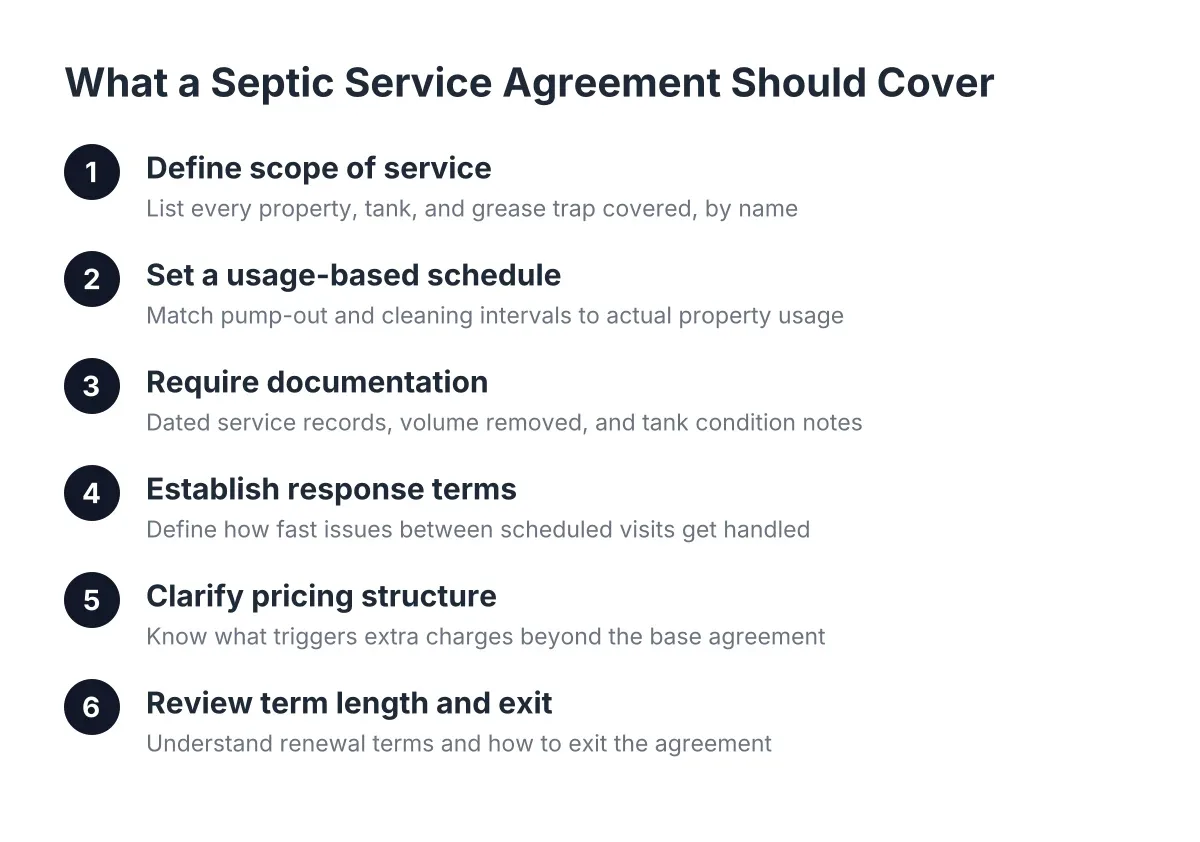
A good agreement does not need to be long, but it does need to be specific. Here are the terms that separate a real service contract from a handshake with a logo on it.
Scope of Service, Spelled Out Property by Property
The contract should name every property, every tank, and every grease trap covered. Not "septic services as needed." That phrase protects nobody. If you manage a small group with three restaurant locations, the agreement should list all three addresses, the type of equipment at each one, and what gets done at each visit.
For a food service operation, scope usually includes some mix of:
- Grease trap clean out on a set schedule, monthly or quarterly depending on volume
- Septic tank pumping and septic tank cleaning at defined intervals
- Septic tank filter cleaning where the system has an effluent filter
- A basic septic system inspection during each visit, with findings in writing
- Sewer tank service for properties on larger commercial systems
If a service is not listed, assume it is not covered. That is not the contractor being sneaky; it is how contracts work. The fix is simple: get everything you expect in writing before you sign.
A Schedule Tied to Your Actual Usage, Not a Generic Calendar
The U.S. Environmental Protection Agency recommends inspecting a septic system every 1 to 3 years and pumping the tank every 3 to 5 years for a typical household. However, a busy commercial kitchen is not a typical household. A restaurant running fryers and grills six days a week loads its grease trap and septic system far harder than any home does.
Therefore, the contract should set intervals based on how each property is actually used. A high-volume restaurant in Little Havana might need grease trap cleaning every month. A small office building on the same street might only need a septic pump out every couple of years. One schedule for both is a sign the contractor has not looked closely at either.
Good contract terms also say what happens when usage changes. Suppose you add a second fryer line or your lunch traffic doubles. The agreement should allow the schedule to tighten without renegotiating the whole contract.
Documentation and Records: The Part Inspectors Actually Read
This is the section most owners skim and most inspectors read first. The contract should commit the service company, in writing, to provide after every visit:
- A dated service record showing what was pumped, cleaned, or inspected
- The volume removed and where it was hauled, which matters for grease trap compliance
- Notes on tank condition, filter condition, and anything that needs attention
- Copies kept on file that you can request later, not just a receipt handed to whoever was at the counter
For example, say a hypothetical cafe owner in Coral Gables gets a surprise visit from a health inspector during a busy Friday lunch. The inspector asks for grease trap records. If the owner can pull twelve months of dated clean out reports from a folder or an email thread, the visit moves on. If the records live in a shoebox at the pumping company's office, or nowhere at all, that Friday gets much longer.
The same logic applies to property managers. A documented septic service history raises the value of the property file. It answers buyer questions during a sale, backs you up in a tenant dispute, and shows an HOA board that maintenance money was actually spent on maintenance.
Response Terms for Problems Between Scheduled Visits
No contract prevents every problem. A grease trap can overflow between cleanings. A tenant can flush something a leach field was never built to handle. The agreement should say how you report a problem and how a service call gets scheduled, so a backup does not turn into a debate about whose job it is.
Be careful with vague promises here. A contract that says "priority response" without defining it is decoration. Better terms describe the process: who you call, what information they need, and how the visit gets confirmed. Clear process beats big promises.
Pricing Structure and What Triggers Extra Charges
You do not need a contract to lock in every dollar, but you do need it to lock in the structure. The agreement should state what the recurring rate covers and what counts as extra. Common extras include pumping a tank that turns out larger than recorded, hauling unusually heavy grease loads, or digging to expose a buried tank lid.
None of those extras are unreasonable. The problem is discovering them on the invoice instead of in the contract. Ask for the trigger conditions in writing, and ask that any extra work be approved before it happens. A local company that plans to keep your business will agree to that without friction.
Term Length, Renewal, and How You Exit
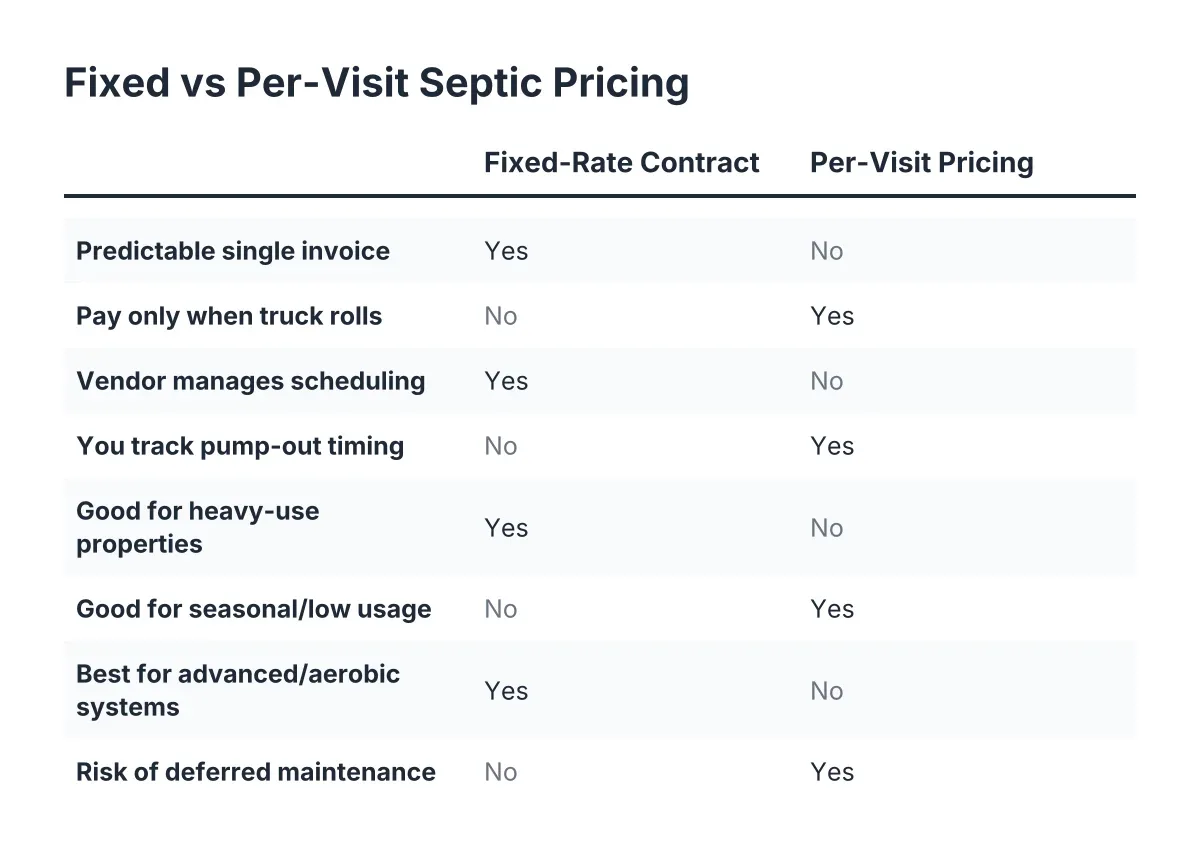
Most commercial septic contracts run one to three years with automatic renewal. That is fine, as long as the exit is fair. Look for a cancellation clause with reasonable notice, usually 30 to 60 days, and no penalty beyond paying for work already done.
Watch for auto-renewal windows that only open for a few days a year. A contract you can only leave during the second week of March is not a partnership. It is a trap with a schedule.
Why Service Contracts Beat One-Off Service Calls
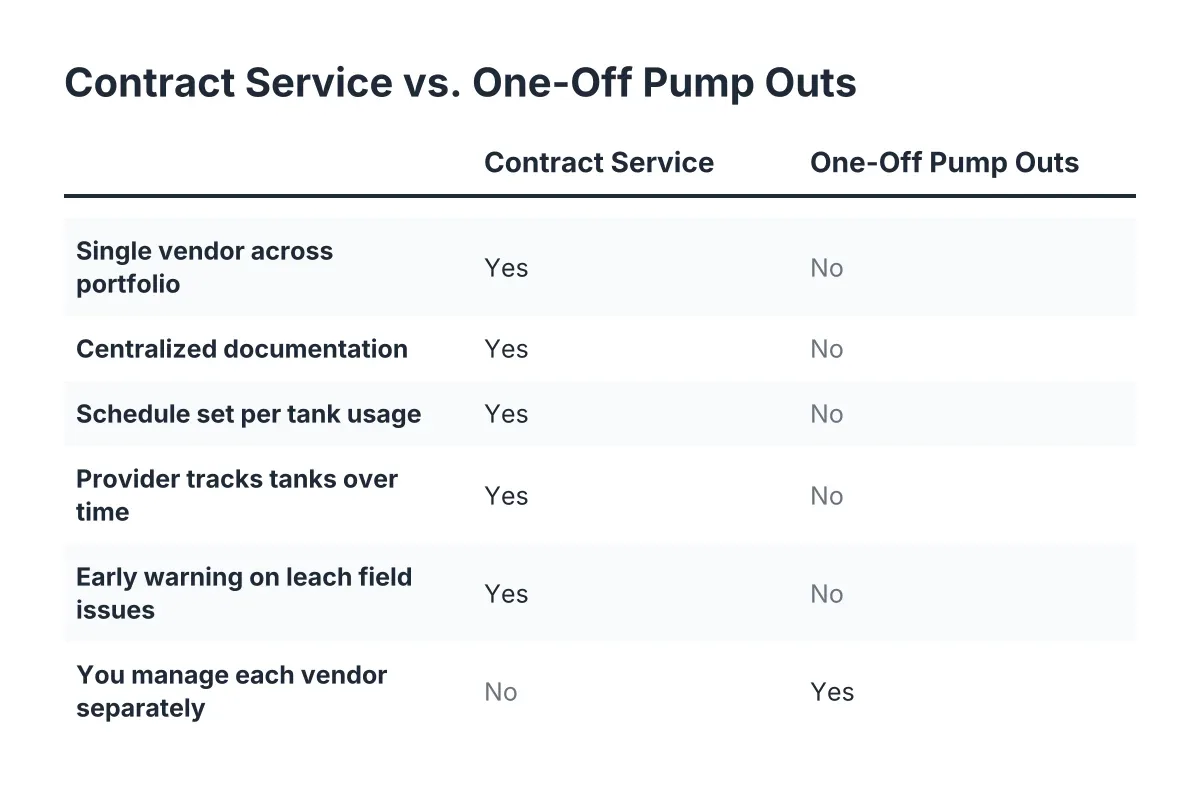
Could you skip the contract and just call a septic cleaner near me search result whenever a tank seems full? You could. Plenty of businesses run that way until the first bad surprise. Here is what the contract approach buys you that one-off calls do not.
First, the schedule runs itself. Nobody on your staff has to remember that the trap at the Miami Beach location is due in March and the tank at the Kendall property is due in June. The service company tracks it, because the contract makes tracking their job.
Second, the records accumulate automatically. Every visit adds to the file. After two years, you have a service history that would take weeks to reconstruct from scattered invoices. That history is what compliance, insurance, and resale conversations all run on.
Third, the math favors prevention. According to the U.S. Environmental Protection Agency, regular septic maintenance costs about $250 to $500 every three to five years for a typical system, while repairing or replacing a failed one runs $5,000 to $15,000. Commercial systems and grease traps carry their own numbers, but the ratio holds. A full septic system replacement cost lands in a different universe than the maintenance that would have prevented it.
Fourth, a single vendor across properties simplifies everything. One contact, one invoice format, one set of records, one company that already knows where every tank lid sits. For a manager juggling five properties, that alone justifies the agreement.
Red Flags in a Commercial Septic Agreement
Some warning signs show up before you ever sign. Keep an eye out for these:
- No site visit before quoting. A company that prices your grease trap contract without seeing the trap is guessing, and you will pay for the guess later.
- Records "available on request" with no commitment. If documentation is not promised per visit, plan on not having it when you need it.
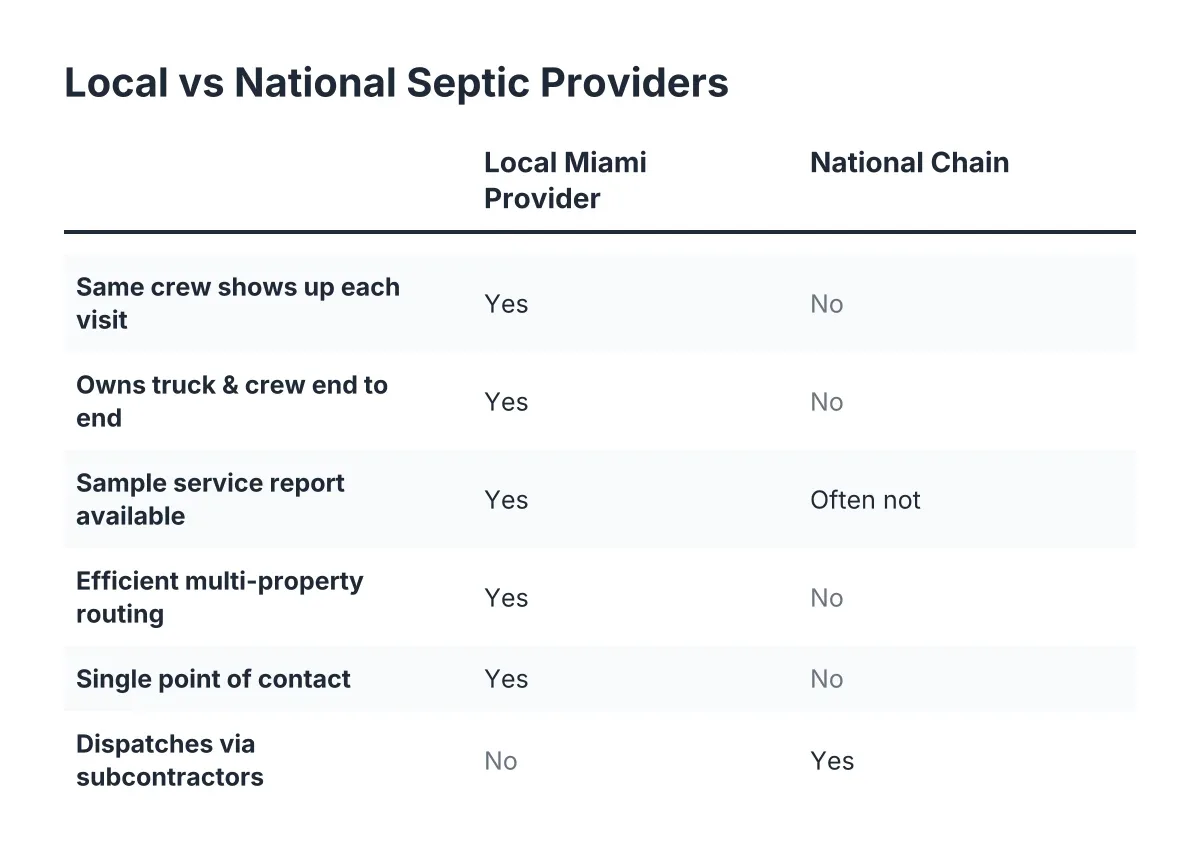
- A call center that is not local. National directories route Miami calls out of state, then sell your job to whoever bids. Your contract should be with the company whose truck shows up, based in the Miami area, answering for its own work.
- Pressure to bundle repairs into the service contract on day one. A maintenance agreement and a leach field repair are separate decisions. A contractor who insists on selling both before pumping a single tank is selling, not assessing.
- No mention of disposal. Pumped waste and grease have to go somewhere legal. The contract should reflect proper hauling and disposal, because if it does not, that liability can circle back to you.
One honest caveat belongs here. A service contract covers maintenance, not engineering. If an inspection turns up a failing drain field, structural tank damage, or repeated backups that pumping does not fix, you need a qualified repair professional to evaluate the system before signing anything long term. Searching septic repair near me is the right move at that point; extending a pumping contract is not.
A Portfolio Example: Three Properties, One Agreement
Suppose a hypothetical property manager oversees three Miami-area properties: a taqueria with a heavily used grease trap, a four-unit rental building on septic, and a small office with light usage. Managed separately, that is three vendors, three schedules, and three chances for something to slip.
Under one agreement, the terms might look like this. The taqueria gets a grease trap clean out every month, with a service record emailed after each visit. The rental building gets a septic tank pumping and filter cleaning on a two-year cycle, with an inspection note each time. Furthermore, the office gets an inspection every year and a pump out when the tank actually needs it, not on a padded schedule that bills for unneeded work.
Every visit lands in the same file. When the taqueria's county compliance deadline comes up in 2026, the records are already sitting in the manager's inbox. When the rental building goes up for sale, the septic service history goes straight into the disclosure package. Nothing heroic happened. The contract just did its job quietly for two years.
That is the honest trade-off, by the way. A contract means paying for structure during years when nothing goes wrong. Some owners look at a quiet year and wonder what they paid for. What they paid for is the year staying quiet, and the paperwork proving they did their part if anyone ever asks.
What to Ask Before You Sign
Bring these questions to any septic pump out companies you are evaluating for a recurring agreement:
- Will the contract list each property, tank, and grease trap by address and type?
- How did you set the service intervals, and what changes them?
- What documentation do I get after each visit, and how do I access past records?
- What is the process for a problem between scheduled visits?
- What triggers charges beyond the recurring rate, and do I approve extras first?
- What are the term length, renewal terms, and cancellation notice?
- Where does the pumped waste and grease go?
A local operator worth a multi-year agreement will answer all seven without hesitation. Vague answers on any of them tell you what the working relationship will feel like after you sign.
Septic systems are easy to ignore because they are buried. The U.S. Census Bureau data cited by EPA shows more than 26 million American homes rely on them, and South Florida's share is large and aging. For a business or a portfolio, the difference between a system that quietly works and one that becomes a five-figure emergency usually comes down to two things: regular service, and contract documentation clear enough that service schedules and terms actually happen on paper, at every property you are responsible for.
If you need septic tank pumping, Miami Septic Tanks can help.
Prefer to talk it through? Call (786) 756-8032 — a quick call is usually the fastest way to get a straight answer for your situation.