Commercial Septic Contracts: Emergency Response, Frequency, and Scheduling Explained
If you manage more than one property on septic in the Miami area, you already know the math. Every tank is a liability sitting underground, and a backup at one building can eat a week of your time. That is why more property managers and HOA boards are evaluating commercial septic contracts, emergency response terms included, instead of calling a different pump-out company every time a drain slows. Handling these situations often requires a structured septic contract emergency response approach. This guide walks through what a recurring service agreement actually covers, how emergency response fits in, how often each property type needs service, and how to compare contracts across a portfolio.
The goal here is not to sell you on a contract. It is to help you evaluate one the way you would evaluate any recurring vendor agreement: what gets documented, who is liable when something goes wrong, and whether one phone number can actually cover everything you own.
Why Portfolio Managers Approach Septic Contracts Differently
A homeowner with one tank can wing it. You cannot. When you oversee ten buildings, a clubhouse, and two restaurant tenants with grease traps, septic stops being a plumbing chore and becomes a documentation and liability problem.
There are about 120,000 septic systems in Miami-Dade County across residential and commercial areas, according to Miami Waterkeeper. A meaningful share of those sit on managed properties: older multifamily buildings, HOA common areas, estate lots in Coral Gables and Coconut Grove, and small commercial strips that never connected to municipal sewer. If your portfolio includes any of them, someone has to answer three questions at any moment:
- When was each tank last pumped, and by whom?
- Is there a paper trail if a tenant, buyer, or inspector asks for service history?
- Who do we call at 6 a.m. on a Saturday when a system backs up?
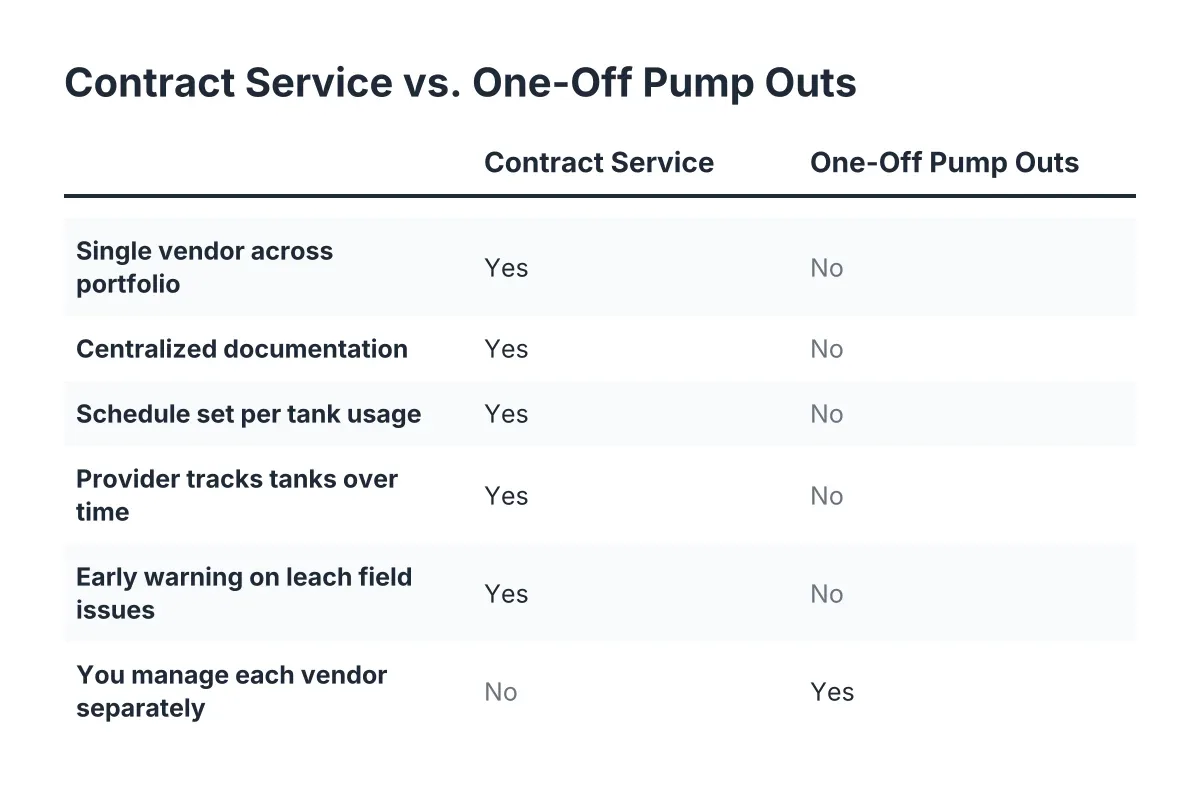
A recurring commercial septic contract exists to answer all three. One vendor, one schedule, one file of service records per property. That is the whole pitch, and the rest of this guide is about whether a given contract actually delivers it.
What a Commercial Septic Contract Usually Covers
A recurring septic service agreement is a schedule plus a scope. The schedule says when each property gets visited. The scope says what happens during each visit. Most contracts for Miami-area portfolios bundle some mix of the following:
- Septic tank pumping and pump outs on a set cycle per property
- Septic tank cleaning, which goes beyond pumping to remove built-up solids from tank walls and baffles
- Septic tank filter cleaning, since a clogged effluent filter is one of the most common causes of slow drains
- Grease trap clean out for any property with commercial kitchens or food-service tenants
- Septic system inspection at each visit, with notes on tank condition, water levels, and early warning signs
- Written service records after every visit, tied to each property address
The last item matters more than most managers expect. A documented septic service history protects you when a unit sells, when an HOA board changes, or when a dispute arises over whether maintenance was neglected. If a leach field fails and someone asks whether the tank was ever pumped, "we have the records" is a much better answer than "I think the last manager handled that."
Watch for what the contract excludes too. Leach field repair, broken pipes, and lift station work usually sit outside a standard maintenance agreement. That is normal. A good contract still names those situations and explains how they get quoted, so a repair does not turn into a negotiation from scratch mid-crisis.
Understanding Emergency Response in Septic Contracts
Emergency response terms are the part of a commercial septic contract that most managers read last and need first. A contract can promise perfect routine service, but the real test comes when a system backs up outside business hours and tenants are calling you instead of the vendor.
Here is the practical distinction to look for. Some agreements are maintenance-only: the vendor pumps on schedule, and anything unplanned is a separate call at whatever rate applies that day. Others include priority handling for contract customers when something urgent comes up. Neither model is wrong, but they price differently and they behave differently at 6 a.m.
Questions worth asking any vendor before you sign:
- If a contracted property has a backup, does the contract get us prioritized over one-off callers?
- Is after-hours work billed at a defined rate, or quoted case by case?
- Does the vendor already have our site details on file, including tank locations and access notes, so a crew is not searching for a lid in the dark?
- Will the urgent visit still generate the same written service record as a scheduled one?
That last point is easy to miss. An emergency pump out that never makes it into your service history creates a gap in your documentation right at the moment you most need the record. When you evaluate commercial septic contracts, emergency visits should feed the same paper trail as routine ones.
One honest caveat: be skeptical of any vendor who promises a specific response time in writing for every scenario. Miami traffic, weather, and crew availability are real constraints for every local operator. A vendor who says "contract customers get priority and here is how dispatch works" is being straight with you. A vendor who promises the impossible is telling you what you want to hear.
How Often Each Property Type Needs Service
Frequency is where portfolio contracts earn their keep, because the right answer differs building by building. The U.S. Environmental Protection Agency recommends inspecting the entire septic system every 1 to 3 years and pumping the tank every 3 to 5 years for typical residential use. That is a sound baseline for single-family homes. Commercial and multifamily properties usually need more.
As a rough guide, here is how usage changes the schedule:
- Single-family rentals and estate lots: pumping every 3 to 5 years, inspection more often, in line with EPA guidance
- Multifamily buildings and clubhouses: shorter cycles, because more people means more solids reaching the tank faster
- Restaurants and food-service tenants: grease trap clean out on its own cycle, often several times per year, separate from septic pumping
- Offices and light commercial: closer to residential intervals, adjusted for headcount and fixtures
Tank size relative to daily flow drives everything. A small tank serving a busy building fills with solids far faster than a large tank serving a quiet one. This is why a good contract starts with an inspection of each property rather than a one-size schedule. The first year of a contract often works as a calibration period: the vendor measures sludge levels at each visit, then adjusts each property's interval based on what the tanks actually show.
However, resist the temptation to stretch every interval to save money. The EPA notes that regular septic maintenance costing $250 to $500 every three to five years is a bargain compared to repairing or replacing a failed system, which can run $5,000 to $15,000. Multiply that repair figure across a portfolio and the case for keeping schedules tight makes itself. One avoided leach field failure can pay for years of routine pump outs.
Scheduling Across Multiple Properties Without the Chaos
The scheduling problem is what separates a portfolio contract from a stack of individual agreements. Say you manage fourteen septic-served properties scattered from Kendall to Key Biscayne. Without a contract, that is fourteen separate reminders, fourteen phone calls, and fourteen chances for a property to slip through until it backs up.
A well-built multi-property septic service agreement replaces that with a single calendar. The vendor tracks which tank is due when, groups nearby properties into efficient routes, and sends you the schedule instead of waiting for your call. You review it once or twice a year. That is the "maintenance schedule I don't have to think about" that most managers are actually shopping for.
For example, suppose an HOA board in the Miami area takes over a community with eight septic-served buildings and no service records. In that scenario, a sensible contract might start with an inspection sweep of all eight tanks in month one, pump the two or three that are overdue, and then place the rest on staggered cycles so the association is not hit with eight pump outs in the same quarter. By year two, the board has a documented septic service history for every building and a predictable line item in the budget. That illustrative sequence is worth more to a board than any brochure.
Staggering matters for cash flow too. A contract that spreads service across the year turns septic from a surprise expense into a planned one. Ask any prospective vendor how they handle initial catch-up work on neglected tanks, and whether the first-year schedule differs from the ongoing one. Both answers tell you how much portfolio experience they actually have.
Documentation and Liability: The Part That Protects You
Service records are the quiet core of any commercial septic contract. Pumping keeps the system working. Paperwork keeps you covered. Every visit should produce a dated record showing the property address, the work performed, tank condition notes, and anything the crew flagged for follow-up.
Those records do real work in at least four situations:
- Property sales, where buyers and inspectors ask when the tank was last serviced
- HOA board transitions, so institutional knowledge does not leave with the outgoing treasurer
- Tenant disputes, where you need to show the backup was not caused by neglected maintenance
- Insurance and compliance questions, where a documented maintenance pattern demonstrates due diligence
Nearly 25 percent of U.S. households, more than 26 million homes, are served by septic systems, according to U.S. Census Bureau data cited by the EPA. Yet documented service history remains the exception rather than the rule, especially at properties that have changed hands. If you inherit a portfolio with no records, the first contracted inspection becomes your baseline, and every visit after that builds the file.
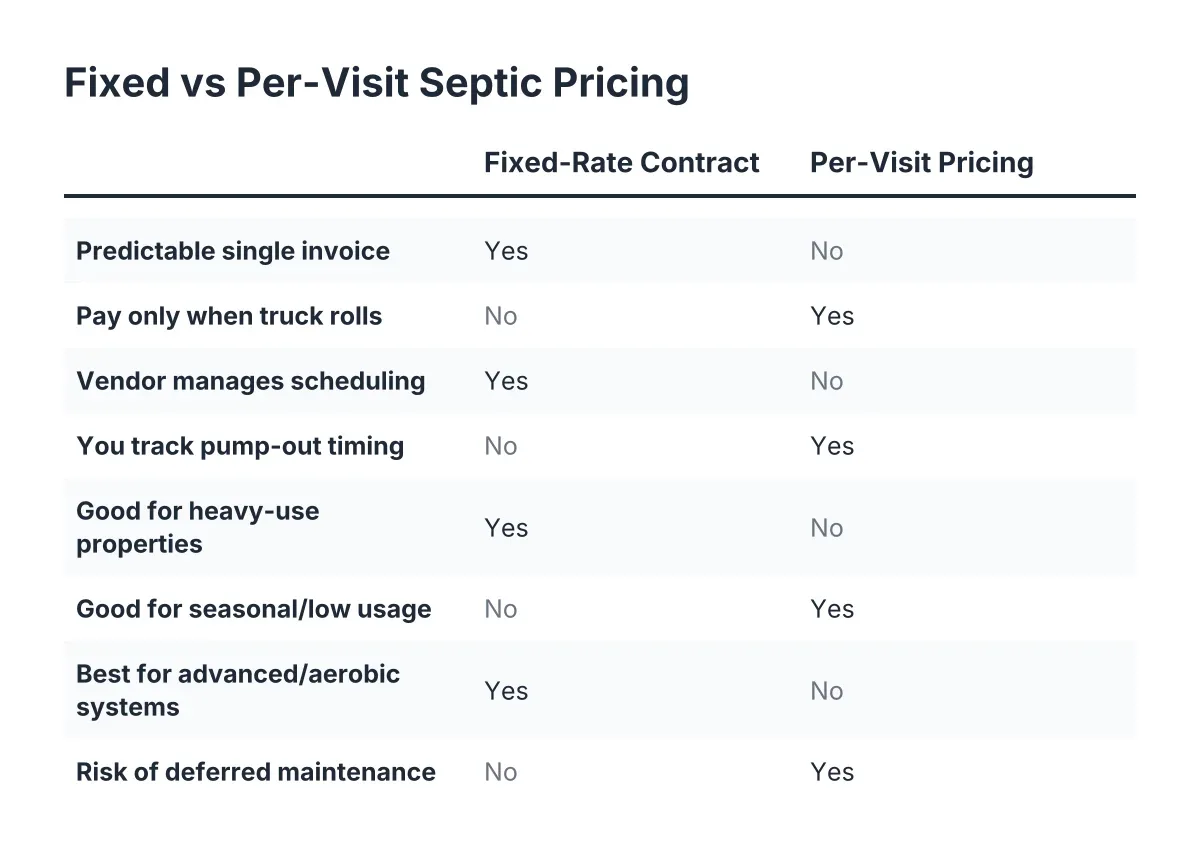
One trade-off to weigh honestly: a contract commits you to a vendor and a schedule, and switching later means re-establishing that relationship and possibly re-baselining your records. If your portfolio is small, or your properties are far apart, comparing a contract against well-organized one-off scheduling is a fair exercise. The contract wins on documentation consistency and priority handling; the one-off approach wins on flexibility. Know which one your situation actually rewards.
Comparing Contracts and Emergency Terms Before You Sign
When you sit down with two or three proposals for commercial septic contracts, emergency provisions and paperwork quality are where they diverge most. The pumping itself is similar from one competent local operator to another. Use this checklist to compare what actually differs:
- Scope per property. Does the agreement list each address with its own service interval, or lump everything into one vague schedule?
- What each visit includes. Pumping only, or pumping plus inspection, septic tank filter cleaning, and condition notes?
- Grease trap handling. If you have food-service tenants, is grease trap clean out on its own defined cycle?
- Emergency terms. Priority handling, after-hours billing, and whether urgent visits generate the same records as scheduled ones.
- Documentation format. Written records per visit, per property, delivered to you, not just kept in the vendor's files.
- Repair boundaries. Clear language on what falls outside the contract, such as leach field repair, and how that work gets quoted.
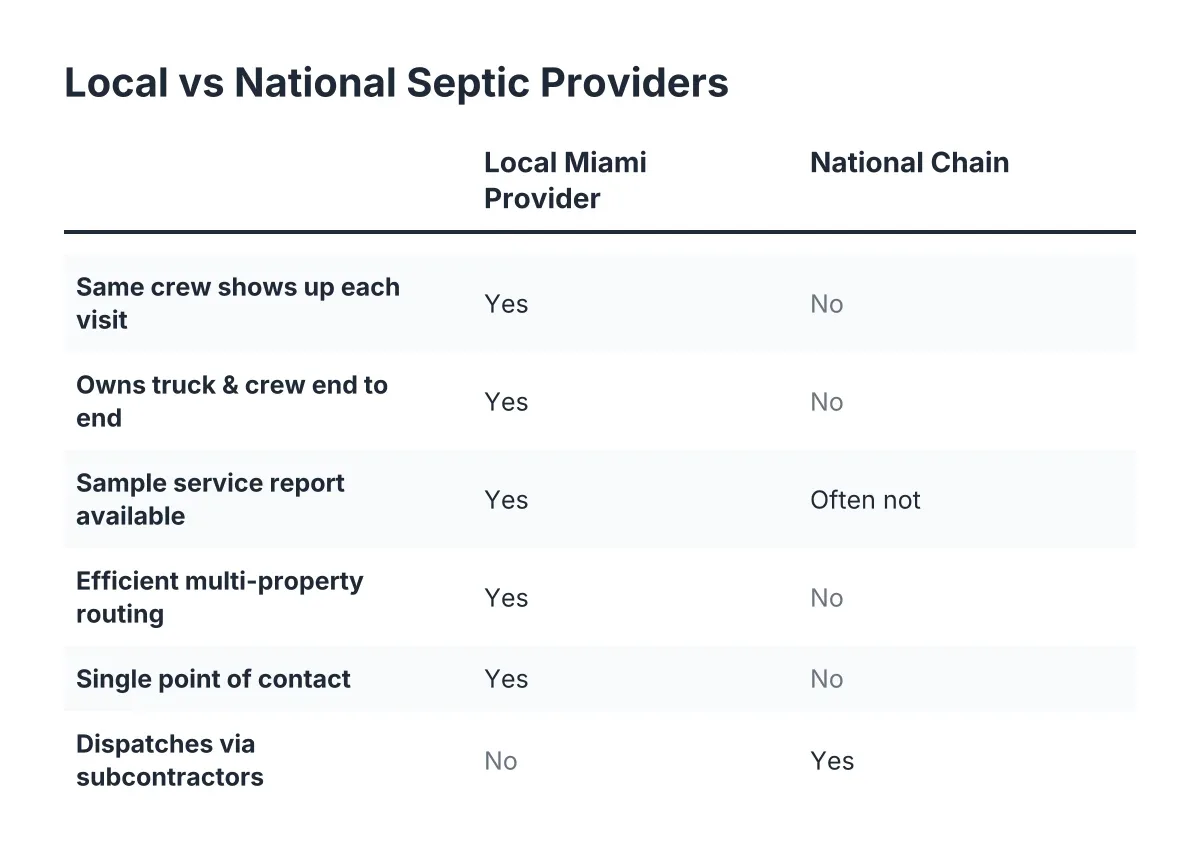
- Local footprint. A Miami-area operator who knows local soil, water tables, and permitting beats a national call center routing your request to whoever answers.
That last point deserves a moment. Some septic pump out companies you find online are aggregators that collect your call and resell it. For a single pump out that is an annoyance. For a multi-year contract covering your whole portfolio, it is a structural problem, because the company holding your service records should be the company doing the work. Ask directly who performs the service and who keeps the records.
Also confirm the exit terms. A reasonable contract lets you leave with your records if the relationship does not work out. Your service history belongs to the properties, not to the vendor.
A Practical Path to Setting This Up in 2026
If you are starting from zero, the sequence is simpler than it looks. First, inventory your septic-served properties: addresses, tank locations if known, last known service dates, and any food-service tenants with grease traps. Gaps are fine; the inventory is the point.
Next, get a baseline inspection on anything with no recent history. You cannot set intervals without knowing what is in the tanks now. Some tanks will be overdue and need an immediate pump out; others will have years of capacity left. As of 2026, EPA guidance still frames the residential baseline as inspection every 1 to 3 years and pumping every 3 to 5, so use that as your starting grid and let inspection results tighten it per property.
Then request proposals structured around your inventory, not a generic plan. A vendor willing to price per property, stagger the schedule, and define emergency terms in writing is showing you how they will behave for the life of the agreement. Finally, put a calendar review in your own workflow once a year. Even the best contract deserves an annual check that the schedule still matches how each property is actually used.
For complex situations, such as a failing leach field, a system near the water table, or a property with repeated backups despite regular pumping, bring in a professional for a full septic system inspection before signing anything. A contract manages a healthy system well; it cannot rescue one that needs repair first, and a good local operator will tell you that plainly.
The bottom line: a portfolio-level septic agreement trades a stack of scattered service calls for one schedule, one point of contact, and one growing file of records per property. Evaluate the emergency terms, the documentation, and the local footprint with equal weight. Get those three right, and septic becomes the least dramatic line item in your maintenance budget, which is exactly what it should be.
If you need septic tank pumping, Miami Septic Tanks can help.
Prefer to talk it through? Call (786) 756-8032 — a quick call is usually the fastest way to get a straight answer for your situation.