Commercial Septic Contract Pricing in Miami, FL: Fixed vs. Per-Visit Rates
If you manage a portfolio of septic-served properties in Miami, FL, commercial septic contract pricing usually comes down to one big fork in the road: choosing between fixed vs per-visit pricing models. Both can work. Both can also go wrong if the contract does not match how your properties actually use their systems. This guide walks through how each pricing model works, which one fits which kind of portfolio, and what to check before you sign, so you end up with documented service history and predictable costs instead of surprise invoices.
The goal here is not to sell you on one model. It is to give you the same framework a septic operator uses when they quote a multi-property agreement, so you can compare bids on equal footing.
Why Pricing Structure Matters More Than the Number on the Quote
Property managers comparing vendor bids tend to look at the bottom line first. That is understandable, but with septic work the pricing structure often matters more than the headline figure. A low per-visit rate can cost more over a year than a fixed contract if your properties need frequent pump outs. A fixed contract can waste money if half your tanks only need attention every few years.
There is also the liability side. HOA boards and management firms need documented septic service history for insurance, pre-sale inspections, and tenant disputes. The pricing model you choose shapes how often a truck shows up, and how often a truck shows up shapes how complete your paper trail is. A contract that only sends someone when a tenant complains produces a thin file. A contract with scheduled visits produces a record you can hand to an insurer or a buyer without apology.
Miami adds its own pressure. According to Miami Waterkeeper, there are about 120,000 septic systems in Miami-Dade County across residential and commercial areas. That is a lot of tanks competing for pump trucks, especially after heavy rain when everyone calls at once. A contract puts your properties on a schedule instead of in a queue.
How Fixed-Rate Septic Contracts Work
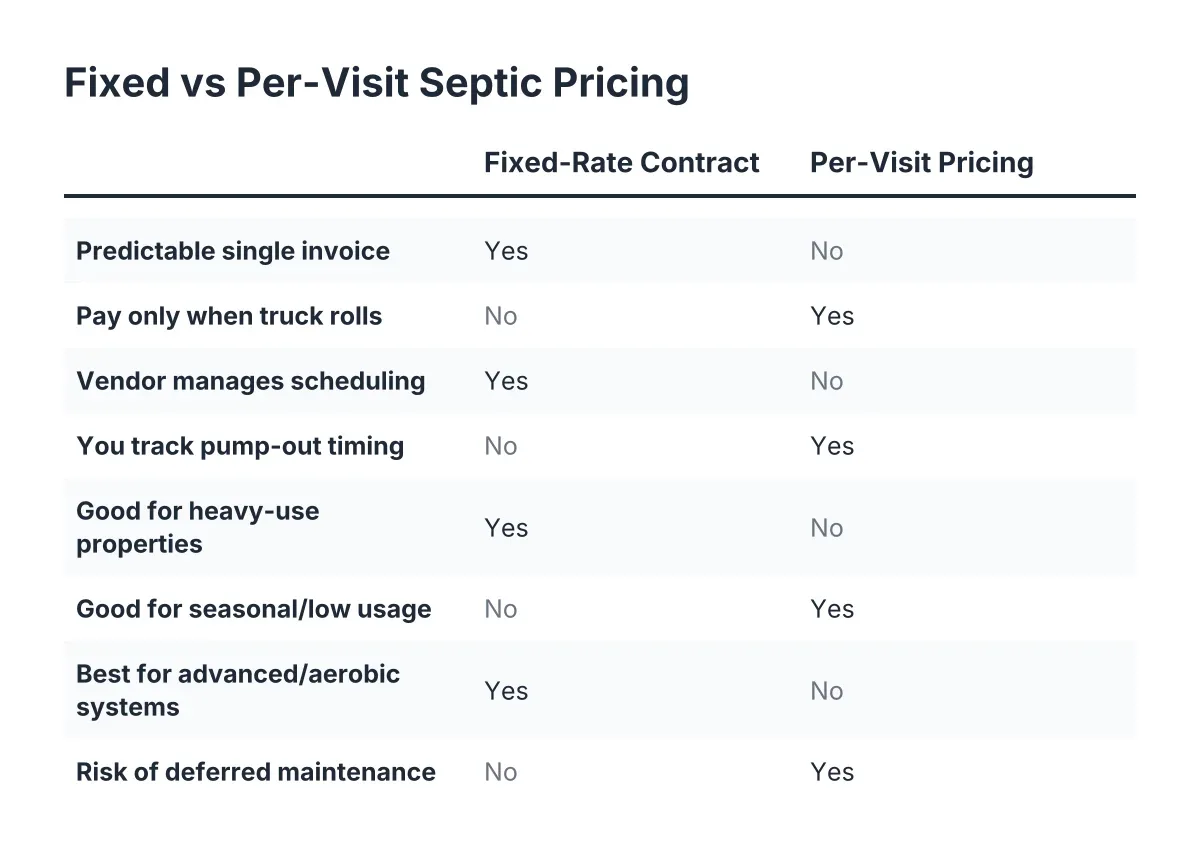
A fixed-rate contract sets one annual or monthly price for a defined scope of work across your properties. The septic company agrees to a schedule, usually built around how fast each tank fills, and you pay the same amount whether a visit is quick or complicated.
A typical fixed-rate agreement for a Miami-area portfolio covers:
- Scheduled septic tank pumping for each property on the agreed cycle
- Septic tank filter cleaning at set intervals
- A basic septic system inspection at each visit, with notes on tank condition
- Grease trap clean out for any properties with commercial kitchens
- Service reports filed after every visit for your records
The appeal for a property manager is obvious. One vendor, one invoice cadence, one budget line you can defend to a board in January and not think about again. The vendor takes on the risk that some tanks need more work than expected; you take on the risk that some tanks needed less.
When fixed pricing favors the portfolio
Fixed pricing tends to win when your properties are heavy users. Commercial buildings and multifamily properties usually need more frequent pumping than a single-family home, because heavy restroom traffic pushes more unknown material into the system. Tenants flush things owners never would. If your tanks fill fast and unpredictably, a fixed rate smooths that volatility into a flat number.
It also wins when documentation is the point. Advanced or aerobic systems, for example, are often required to have a maintenance contract in place because of their complexity. If any properties in your portfolio run those systems, a fixed agreement with scheduled visits is usually the cleanest way to stay compliant and keep the records to prove it.
How Per-Visit Pricing Works for Commercial Properties
Per-visit pricing is exactly what it sounds like. You pay a set rate each time the truck comes out for a septic tank pump out, a filter cleaning, or a grease trap clean out. Some septic pump out companies offer a light version of a contract on top of this: a per-visit rate schedule locked in for the year, sometimes with a discount for committing your portfolio to one vendor.
This model keeps you in control of spending. Nothing gets billed unless a truck rolls. For a portfolio where most tanks are large relative to occupancy, or where usage is seasonal, per-visit pricing can cost less over a multi-year window.
However, per-visit pricing shifts the scheduling burden onto you. Someone on your team has to track when each tank was last pumped, when the next septic system cleaning is due, and which grease traps are approaching their limit. If that tracking slips, you drift back into reactive mode, and reactive mode is where expensive failures live.
The hidden cost of per-visit contracts
The real risk with per-visit pricing is not the rate; it is the skipped visit. When each pump out is a separate spending decision, there is a temptation to defer. A deferred pump out lets solids carry over into the leach field, and leach field repair is one of the costliest jobs in septic work. The U.S. Environmental Protection Agency notes that routine maintenance running $250 to $500 every three to five years is a bargain next to repairing or replacing a failing system, which can run $5,000 to $15,000. Those are residential figures, and commercial systems scale up from there, but the ratio is the lesson: skipping maintenance to save on visits is how you buy a repair.
Comparing Commercial Septic Contract Pricing Models Side by Side
When you put fixed and per-visit models next to each other, the decision usually turns on four questions. Work through them for your portfolio before you request bids.
- How predictable is usage? Stable, full-occupancy multifamily buildings favor fixed pricing. Seasonal or low-occupancy properties favor per-visit.
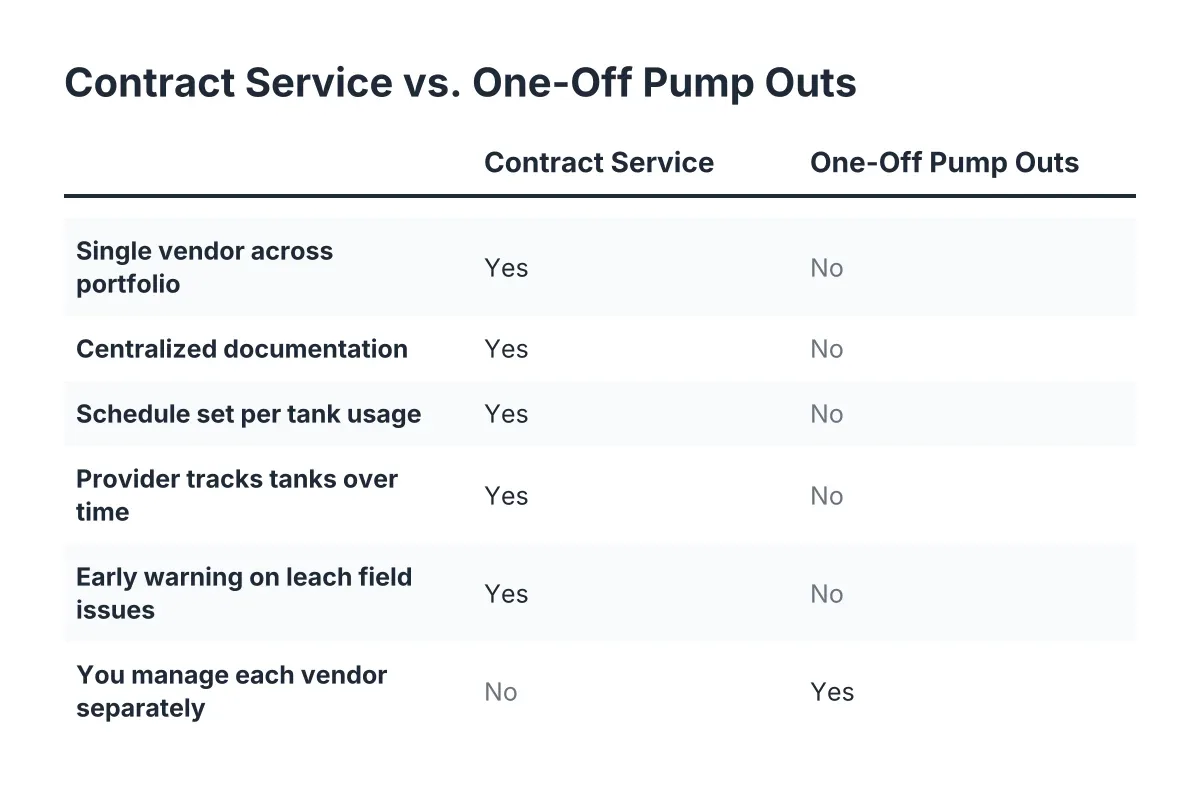
- Who tracks the schedule? If your team has bandwidth to manage pump out timing across every property, per-visit works. If not, fixed pricing buys you a vendor who tracks it for you.
- How important is the paper trail? If your board, insurer, or lenders expect documented septic service history, scheduled visits under a fixed contract build that file automatically.
- How many properties are on septic? As a rough illustration, larger portfolios of septic-served properties often see better terms on a fixed agreement, since a vendor may be able to route visits more efficiently. One or two properties rarely justify a contract over one-off service.
Notice that none of these questions is "which quote is lower." Commercial septic contract pricing only makes sense in the context of how your properties behave over a full year, not a single visit.
A hypothetical Miami portfolio: Fixed vs per-visit approaches
Suppose a management firm oversees twelve septic-served properties around the Miami area: eight small multifamily buildings, three mixed-use buildings with restaurant tenants, and one office property. Under a per-visit model, the firm pays for each septic tank pumping and each grease trap clean out as it happens. In a quiet year, that might mean fifteen visits. In a busy year, with a wet season, a tenant turnover surge, and two backed-up grease traps, it might mean twenty-five visits plus after-hours calls, and the annual spend swings hard.
Under a fixed contract, in that scenario, the same firm pays one negotiated annual figure. The vendor pumps each tank on a set cycle, cleans the restaurant grease traps monthly or quarterly as their volume demands, checks filters, and files a report after every stop. The busy year and the quiet year cost the same, and at renewal the firm has a full service log for every address. Neither outcome is automatically cheaper; the fixed model trades possible savings in quiet years for protection in busy ones.
What Actually Drives the Price of a Commercial Septic Contract
Whichever model you choose, the same underlying factors set the numbers on the quote. Understanding them helps you read bids critically instead of just comparing totals.
Tank size and count. More tanks and bigger tanks mean more truck time and more disposal volume. Pumped waste is hauled by truck to a treatment plant for disposal, according to New Hampshire Department of Environmental Services, so disposal fees scale with what comes out of your tanks.
Usage intensity. A restaurant tenant changes everything. Grease trap cleaning on a tight cycle is non-negotiable for food service, and it adds visits that a purely residential building never needs.
Pumping frequency. The EPA recommends inspecting a septic system every one to three years and pumping every three to five years for a typical home. Commercial and multifamily properties usually run shorter cycles because of heavier use, and each step down in cycle length raises the annual cost.
Access and location. Buried lids, landscaping over tanks, tight parking, and long hose runs all add time. Spread-out portfolios cost more to serve than clustered ones, though a single vendor routing multiple nearby properties can offset some of that.
Local market conditions. Septic pricing tracks supply and demand: how many pump trucks operate in an area relative to the density of septic-served properties. Miami-Dade's large septic population supports a competitive market, which generally works in a buyer's favor when you bid out a multi-property agreement in 2026.
Scope beyond pumping. Septic tank filter cleaning, sewer tank service, inspection reporting, and minor repair allowances all move the price. Be sure every bid defines the same scope before you compare numbers.
Reading a Contract Bid Without Getting Burned
Once bids come in, the comparison work starts. Two quotes with the same total can describe very different agreements. Here is what to pin down in writing before you sign a commercial septic contract for your portfolio.
First, confirm what a "visit" includes. Does the pump out cover the full tank or only the liquid layer? Is filter cleaning part of the pumping visit or billed separately? A cheap visit rate that excludes the filter is not cheap.
Next, look at the reporting. Every visit should produce a written report: date, property, tank condition, sludge level, filter status, and anything the technician flagged. For an HOA septic maintenance plan or a management portfolio, these reports are the product as much as the pumping is. They are what you show an insurer, a buyer, or a board member asking why the line item exists.
Then check the repair language. Most contracts cover maintenance, not repair. Leach field repair, riser replacement, or baffle work usually falls outside the base agreement. That is normal, but the contract should say how repair pricing is set when problems turn up during a scheduled visit, so you are not negotiating from a weak position with a truck in the driveway.
Finally, be skeptical of additive-heavy pitches. Some vendors bundle tank additives into contracts as a value add. Research from university extension programs, according to Washington State University Extension, finds that additives marketed to dissolve sludge lack strong scientific backing, and some can lead to more frequent pumping over time. Scheduled pumping does the job; additives mostly pad the invoice.
Where Fixed and Per-Visit Pricing Each Fall Short
No pricing model is honest if it hides its weak points, so here are both. Fixed contracts can overcharge portfolios with light usage. If a tank genuinely only needs pumping every four years, paying for annual visits to it wastes money, and a fair vendor will set that property on a longer cycle rather than defaulting everything to yearly. Push back on any bid that puts every tank on the same schedule regardless of size and occupancy.
Per-visit pricing can undercharge you into trouble. The invoice looks small in year one, and by year three deferred pump outs have loaded solids into a drain field. A residential septic system has two main parts, a tank and a drain field that disperses clarified liquid into the soil, according to US EPA, and the drain field is the part you cannot pump your way out of once it fails.
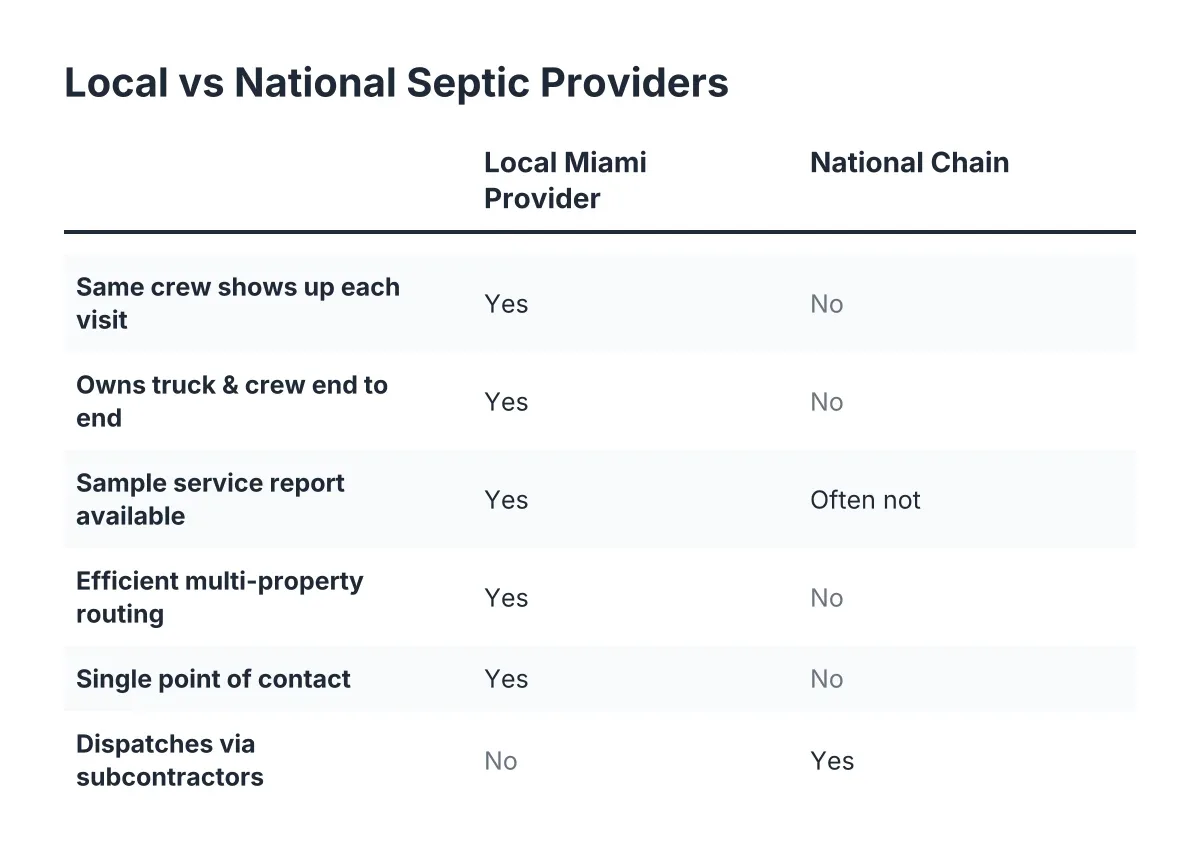
There is also a scale floor. If you manage only one or two septic-served properties, a contract rarely beats calling a local septic cleaner near you when the cycle comes due. Contracts earn their keep on portfolios where routing, scheduling, and documentation compound across many addresses.
One honest caveat applies to everything above: septic systems vary by tank size, soil, age, and use, and no article can price your specific portfolio. Use this framework to structure bids, then have a local septic company walk your properties before committing to a multi-year figure.
Getting Portfolio Bids Right in Miami, FL
For property managers in Miami, FL, the practical path looks like this. Inventory your septic-served properties, including tank locations, last known pump out dates, and any grease traps. Decide which pricing model fits your usage pattern using the four questions above. Then request bids that quote the same defined scope, so you compare structure against structure, not just totals.
Ask each bidder how they document visits, how they handle repairs found during service, and how they schedule around Miami's wet season when demand for pump trucks spikes. A vendor with clear answers to those three questions is telling you they have done portfolio work before.
More than one in five U.S. households rely on septic or small cluster systems, according to U.S. Environmental Protection Agency, and in Miami-Dade the commercial share of those systems is large. The properties that stay off the emergency list are the ones on a schedule with a paper trail. Whether you get there through a fixed annual agreement or disciplined per-visit service, the structure of your commercial septic contract pricing is what turns septic from a recurring crisis into a line item you set once and review at renewal.
If you need septic tank pumping, Miami Septic Tanks can help.
Prefer to talk it through? Call (786) 756-8032 — a quick call is usually the fastest way to get a straight answer for your situation.