Multi-Location Commercial Septic Contracts: One Vendor, Every Property, Full Paper Trail
If you manage septic service across more than one property, you already know the problem is not the pumping. It is the coordination. A multi-location septic contract exists to solve that: one agreement, one vendor, one service calendar, and one file of documentation covering every tank, grease trap, and leach field in your portfolio. Whether you run three restaurant locations across Miami or manage an HOA with a dozen septic-served homes, the question is the same. Do you keep juggling one-off pump outs at each address, or do you put the whole portfolio under a single recurring contract?
This guide walks through what that decision actually involves. We will cover what a multi-location agreement includes, how it protects you on compliance and liability, what it tends to cost relative to one-off service, and how to evaluate a provider before you sign anything.
Why Managing Septic Service Property by Property Breaks Down
One property on septic is manageable. You get a reminder every few years, you call a septic cleaner near me result, someone pumps the tank, and you move on. That approach falls apart fast once you are responsible for multiple locations.
First, the schedules drift. Each property fills at a different rate depending on use. A restaurant kitchen loads its grease trap far faster than a rental duplex loads its septic tank. Commercial buildings with heavy restroom traffic need pumping more often than homes, because more people means more waste and more unknowns going down the drain. Without a single calendar, some tanks get pumped too often and others get forgotten until they back up.
Second, the paperwork scatters. Say a health inspector asks a restaurant operator for proof of the last grease trap clean out at one of three locations. If each site used a different vendor, the manager is now digging through emails, texts, and paper invoices from three companies. One missing receipt can turn a routine inspection into a flagged violation.
Third, one-off vendors have no stake in your portfolio. A company doing a single pump out has no reason to track your tanks over time, warn you that a leach field is showing early trouble, or plan cleanings around your dinner rush. You become the project manager for a trade you did not sign up to manage.
What Multilocation Commercial Septic Contracts Actually Cover
A multi-location contract is a recurring service agreement that puts every septic-served property you control under one vendor and one schedule. The core promise is simple: the provider tracks what each site needs and shows up before problems start, and you get a documented record for every visit.
A well-built agreement typically covers:
- Scheduled septic tank pumping at each property, on a frequency set per tank rather than one blanket interval
- Septic tank cleaning and septic system cleaning beyond a basic pump out where sludge buildup calls for it
- Grease trap clean out on a compliance-driven schedule for food service locations
- Septic tank filter cleaning at properties with effluent filters, which clog long before the tank itself is full
- Septic system inspection on a regular cycle, so small issues surface before they become leach field repairs
- Service documentation for every visit: date, property address, what was pumped or cleaned, tank condition, and any concerns noted
Some items usually sit outside the base contract. Leach field repair, tank repairs, riser installation, and any excavation work are typically quoted separately when a problem is found. That is normal. The contract covers maintenance and monitoring; repairs are their own scope. What matters is that the contract obligates the provider to tell you, in writing, when a repair need shows up.
Frequency is the part that should be customized, not copied. The U.S. Environmental Protection Agency recommends inspecting the entire septic system every 1 to 3 years and pumping the tank every 3 to 5 years for typical use. A busy household of four may need pumping every two to three years, according to Penn State Extension. A commercial kitchen's grease trap can need service several times a year. Additionally, a good multi-property agreement sets each site's interval based on how the site is used, then adjusts as service history builds.
The Documentation Case: Compliance and Liability Across a Portfolio
For anyone overseeing multiple properties, the documentation may be worth more than the pumping itself. Septic and grease trap service is a compliance matter, not just a plumbing chore, and the paper trail is what protects you.
Consider the restaurant side first. Grease trap maintenance is tied to health code and local wastewater rules. When an inspector shows up, "we had it cleaned recently" carries no weight. A dated service record from a professional provider does. Under a portfolio contract, every location's grease trap history lives in one file. If a location gets flagged, you can show a consistent cleaning schedule going back years, which changes the conversation with the inspector entirely.
Septic service works the same way. Providers commonly file a standardized report with the local county for each tank pumped, and a similar report format is used for real estate transactions. If you ever sell a property, refinance, or face a dispute with a tenant over a backup, a documented septic service history is your evidence that the system was maintained on schedule.
Liability is the other half. Suppose a tenant at one of your rental properties reports sewage surfacing in the yard, and the situation ends up in a dispute. In that hypothetical, a landlord with a signed maintenance contract and dated service records at every property is in a far stronger position than one who pumped tanks whenever someone complained. The contract itself shows a pattern of responsible maintenance.
This matters in Miami specifically. Miami-Dade County has about 120,000 septic systems across residential and commercial areas, according to Miami Waterkeeper. Septic systems here sit close to a high water table and environmentally sensitive waterways, so local scrutiny of failing systems is real and growing. As of 2026, property owners with septic-served buildings should expect documentation questions, not fewer of them.
There is also the money argument. According to the U.S. Environmental Protection Agency, regular maintenance costing $250 to $500 every three to five years is a bargain compared to repairing or replacing a failed system, which can run $5,000 to $15,000. Multiply that across a portfolio and the math gets loud. One neglected tank that kills a leach field can cost more than years of contracted maintenance across every property you manage.
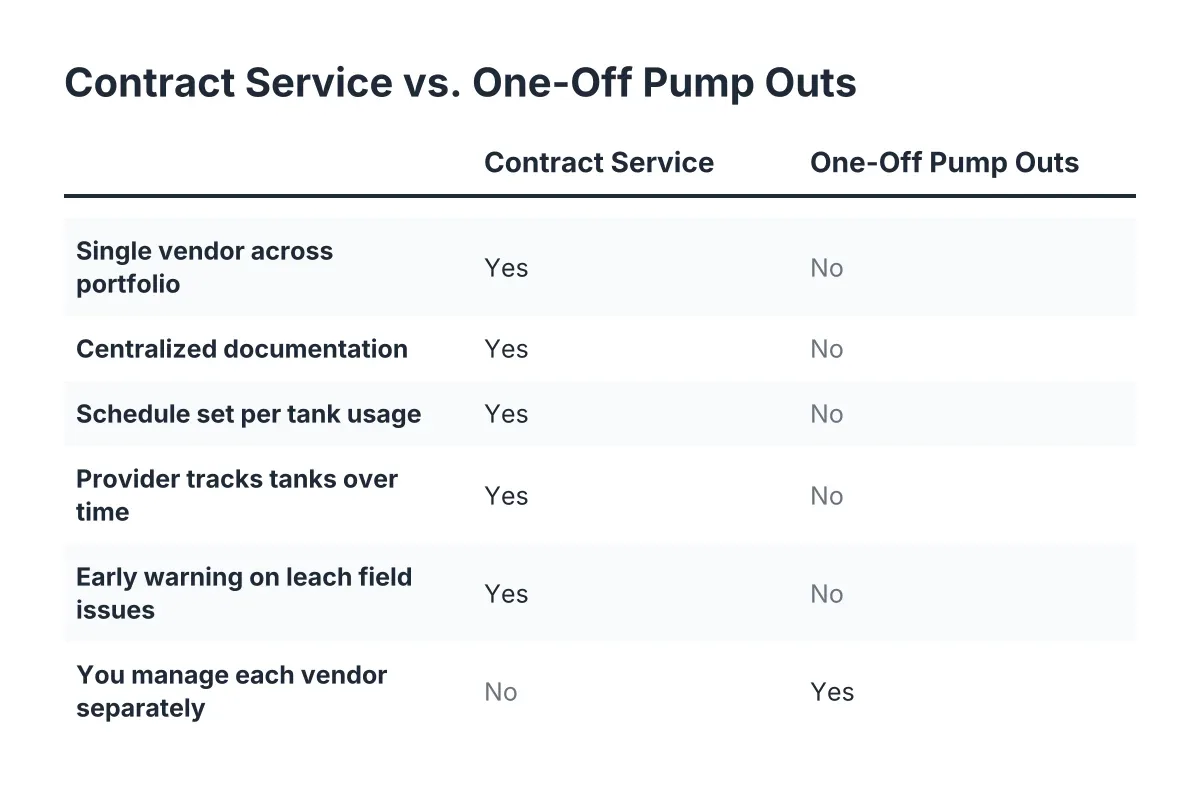
Contract Service vs. One-Off Pump Outs: An Honest Comparison
A recurring contract is not automatically the right answer for everyone. Here is the trade-off, laid out plainly.
One-off service works fine when you have one or two low-use properties, stable tenants, and a good calendar habit. You pay only when a truck shows up, you can shop septic pump out companies on price each time, and you carry no ongoing commitment. The downside is that you own the scheduling, the record keeping, and the risk of forgetting. You also start from zero with each vendor, who knows nothing about your tanks.
A multi-location contract flips those trade-offs. You commit to a recurring relationship and a predictable service cadence. In exchange, you get:
- One point of contact for every property, instead of a different dispatcher per site
- A vendor who knows your systems, including which tank runs heavy and which grease trap fills fast
- Consolidated billing and records, one file instead of a shoebox of invoices
- Scheduling built around your operations, such as grease trap service outside restaurant hours
- Early warnings, because a provider who inspects on a cycle catches slow drains, filter clogs, and leach field trouble before they become shutdowns
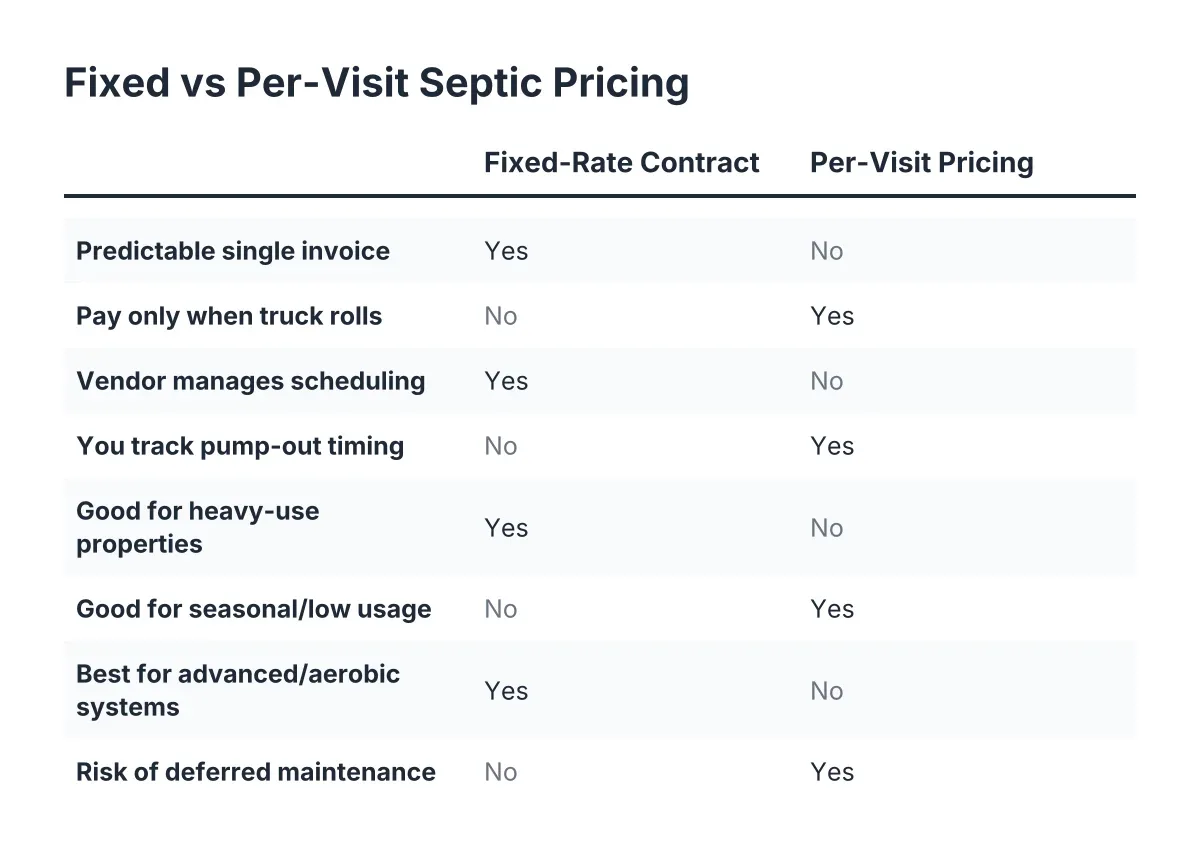
The honest limitations: you may pay for some visits that a perfectly attentive owner could have stretched, and you are tied to one vendor's reliability. If the provider is bad, the contract concentrates the problem. That is why vendor evaluation, covered below, matters more for a portfolio contract than for any single pump out. Also, contracts do not replace judgment on repairs; leach field repair, system replacement, or relocation involves permits and licensed installation work, since counties treat septic construction as a public health matter. For anything beyond maintenance, get a professional assessment before committing money.
For food service operators, one more point. Some past vendor frustration comes from mismatched expectations, not bad companies. A one-off vendor has no obligation to remember you exist next quarter. A contract creates that obligation on paper, with a schedule you can hold the provider to.
What a Restaurant Group Gains From a Multi-Location Septic Contract
Restaurant operators feel multi-location pain more sharply than anyone, so it is worth a concrete illustration. Suppose you run three restaurants in the Miami area. Two are on municipal sewer but have grease traps; the third sits on a septic system with its own tank and leach field. Last year, one location got flagged at inspection because the grease trap log had a four-month gap. Another had drains slow down and smell during a Friday dinner rush, which is the exact night you cannot absorb a backup.
Under one-off service, that operator is managing three separate maintenance realities. Each kitchen manager calls whoever answers first when drains slow. Records live in three places, if they exist at all. The septic-served location gets pumped when someone remembers, which is usually after a symptom appears.
Under a single portfolio contract, the picture changes. The provider services each grease trap on an interval matched to that kitchen's volume, scheduled during off hours so service never touches a shift. The septic location gets tank pumping and septic tank filter cleaning on its own cycle, with an inspection that watches the leach field. Every visit generates a dated record, so when the inspector asks, the manager pulls one file. The gap that caused last year's flag cannot happen again, because the schedule is the vendor's job to keep, not the kitchen manager's.
The same logic scales to HOAs and residential property managers. An HOA septic maintenance plan covering a dozen septic-served homes in areas like Coral Gables, Coconut Grove, or Key Biscayne estate lots gives the board one budget line, one vendor, and one report to show homeowners. Given that more than one in five U.S. households depend on septic or small cluster systems, according to the U.S. Environmental Protection Agency, plenty of managed communities carry exactly this responsibility without a plan behind it.
Miami-Area Factors That Shape a Multi-Location Septic Contract
Local conditions should shape the contract, and Miami has a few that matter. The region's high water table and heavy seasonal rain put stress on drain fields. A conventional system has two main parts, the septic tank and the drain field, according to the U.S. Environmental Protection Agency, and in South Florida the drain field is usually the vulnerable half. Saturated soil during the rainy season leaves less room for effluent to disperse, so a tank that is overdue for pumping fails faster here than it might elsewhere.
For a portfolio contract, that argues for two things. First, inspection frequency should lean toward the shorter end of the recommended range for properties with older or low-lying drain fields. Second, service history matters; a provider who has pumped your tanks before knows which sites struggle in the wet season and can front-load service before summer rains.
One more local reality: not every property in a Miami portfolio is on septic. Homes and buildings in areas with centralized sewer connect directly to municipal treatment, as the Environmental Finance Center Network notes, while septic serves areas without that service. A useful portfolio agreement handles the mix, covering septic tank pumping and sewer tank service where systems exist and grease trap cleaning at food service sites regardless of sewer connection. Waste pumped from tanks is trucked to a treatment plant for disposal, per New Hampshire Department of Environmental Services, so proper disposal documentation should be part of your records too.
Skip the shortcut products. Additives marketed to dissolve sludge lack strong scientific backing, according to Washington State University Extension. No additive replaces a scheduled pump out, and no contract should lean on them.
How to Evaluate a Provider for Multi-Location Septic Contracts
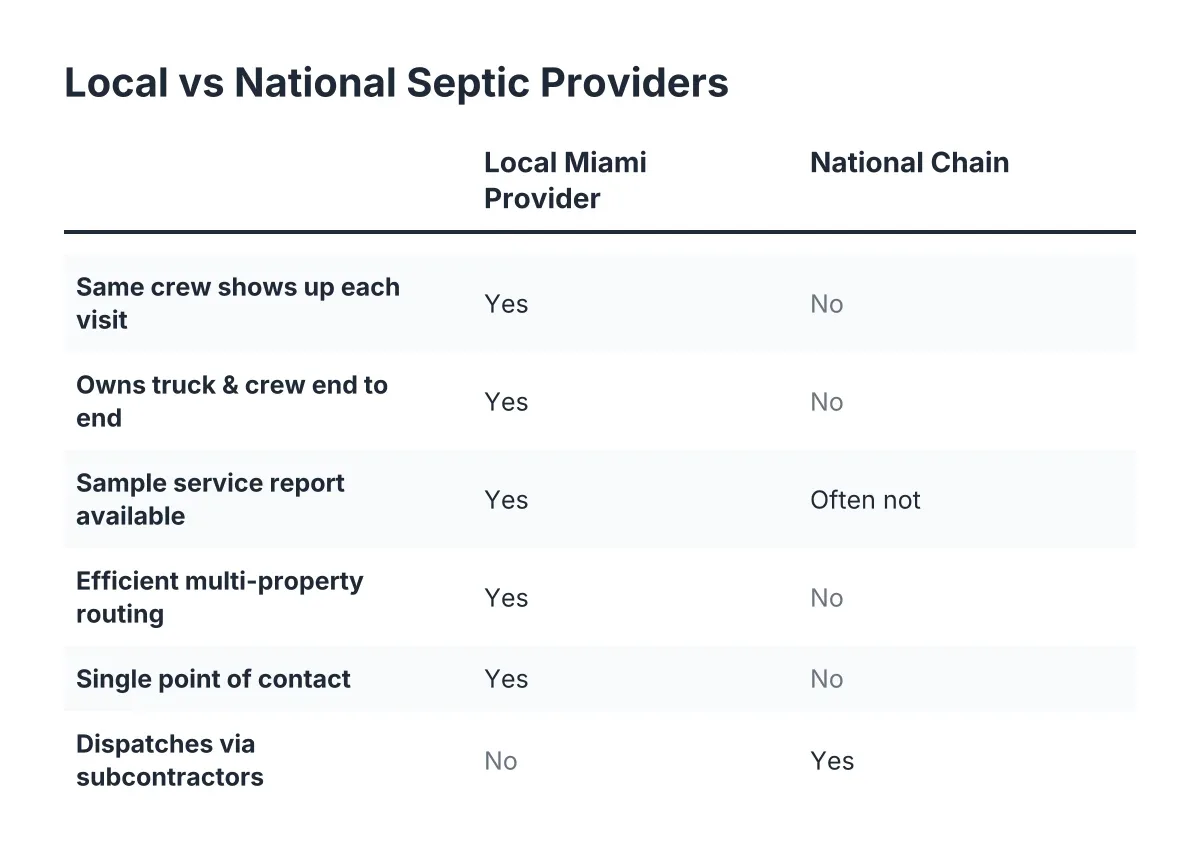
Choosing a vendor for a portfolio agreement deserves more scrutiny than picking someone for a single pump out, because you are concentrating your compliance risk in one company. Three questions do most of the work.
First, ask what documentation you get after every visit. The right answer is specific: a dated service record per property showing what was done, tank or trap condition, and any flagged concerns, delivered in a format you can hand to an inspector or keep in a property file. If the answer is vague, the paper trail you are buying does not exist.
Second, ask how they set service frequency per site. A provider who quotes one interval for every property has not thought about your portfolio. The right answer accounts for use: kitchen volume for grease traps, occupancy for residential tanks, and inspection findings over time. The schedule should tighten or loosen as history builds.
Third, ask how scheduling works around your operations. For restaurants, that means service outside business hours and a schedule the vendor keeps without being chased. For rentals and HOAs, it means coordinated tenant notice and access. A vendor who hesitates here will be a vendor you chase later.
A fair quote for a multi-location agreement itemizes each property, states the service frequency and scope per site, separates maintenance from repair work, and spells out what a service record includes. Be cautious of a single flat number covering everything with no per-site detail; you cannot audit what you cannot see. It is also fair to compare the contract total against what the same visits would cost as one-offs. The contract should earn its keep through scheduling, documentation, and early problem detection, not through hidden markup.
If you are earlier in the research process, it helps to read up on how commercial septic contracts are structured in general, including standard terms, scope, and emergency provisions, before negotiating a multi-property version.
Putting a Portfolio Plan in Place
The practical path is straightforward. Inventory your properties: which are on septic, which have grease traps, and when each was last serviced. Pull whatever records exist, even partial ones. Then bring that inventory to a local Miami-area provider and ask for a per-site plan with frequencies, scope, and documentation spelled out.
A multi-location septic contract will not make septic systems exciting, but it will take them off your list of things that can blow up a Tuesday. One vendor, one schedule, one file of records that satisfies inspectors, protects you in disputes, and catches problems while they are still cheap. For anyone responsible for more than one septic-served property in Miami, FL and surrounding areas, that is the whole case.
If you are ready to compare a contract against your current patchwork of one-off pump outs, reach out to a local septic service for an estimate. Bring your property list and your last service records, and ask for a per-site plan you can hold them to.
If you need septic tank pumping, Miami Septic Tanks can help.
Prefer to talk it through? Call (786) 756-8032 — a quick call is usually the fastest way to get a straight answer for your situation.