Compare Commercial Septic Contracts: Local Miami Providers vs. National Chains
If you manage restaurants, run an HOA, or oversee a portfolio of septic-served properties around Miami, you have probably typed some version of "septic service contract" into a search bar and gotten a mess of results. Before you sign anything, it pays to compare commercial septic contracts from local and national providers, weighing what local vs. national septic service means for your portfolio. The paperwork can look identical. The service behind it is not. This guide walks through what a real commercial contract should include, where local and national providers differ, and how to check the details that protect you when a health inspector or a home buyer's attorney asks for your service records.
Why Local vs. National Septic Service Matters More for Commercial Contracts
A homeowner who picks the wrong pump out company loses a Saturday morning. A restaurant operator or property manager who picks the wrong contract holder can lose a health inspection, a closing date, or a tenant. Commercial septic and grease trap work is a documentation business as much as a pumping business. Every service visit should leave a paper trail you can hand to a county inspector, an insurer, or a buyer's agent without apologizing for gaps.
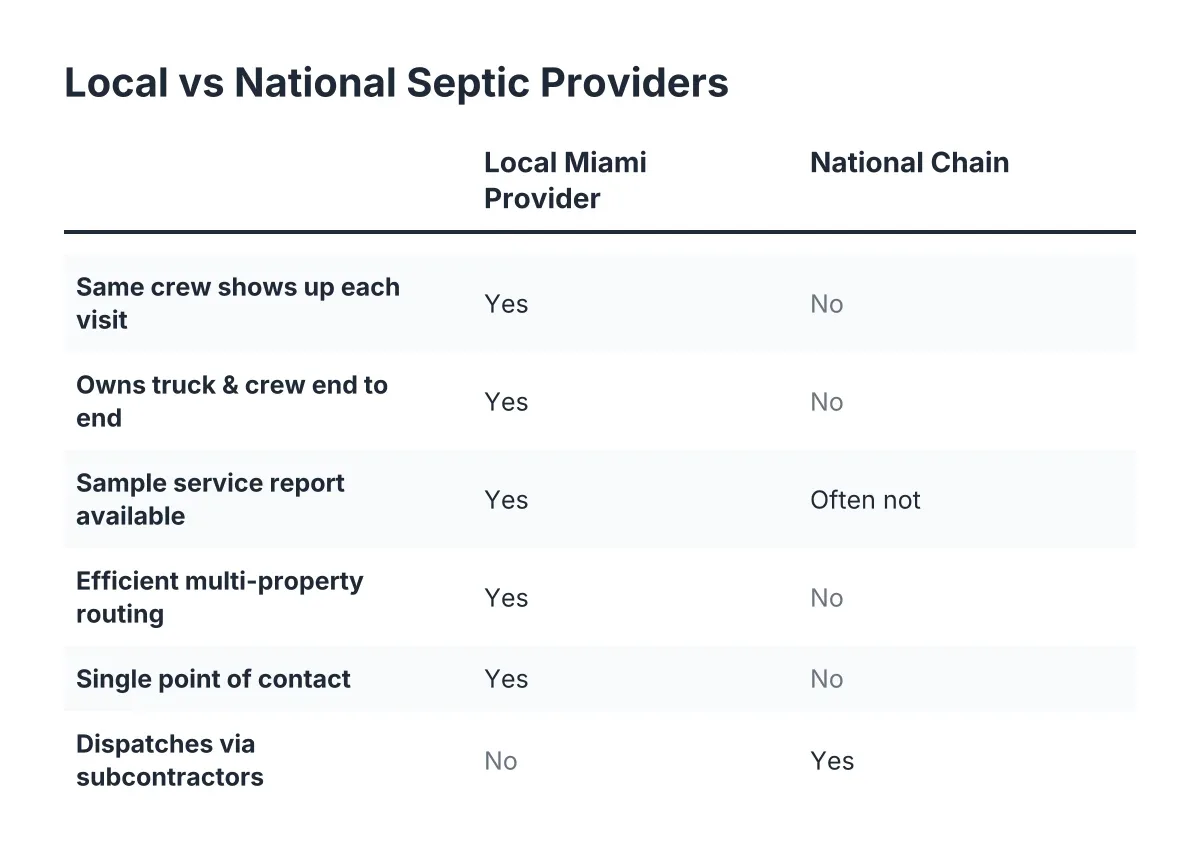
That is where the local vs. national split shows up. National chains and aggregator sites sell you a phone number and a promise. The truck that shows up is often a local subcontractor you never chose, working under someone else's paperwork standards. A local Miami-area provider with its own trucks and its own crews owns the whole chain, from the visit to the report to the disposal manifest.
The stakes are not small here. Miami-Dade County has about 120,000 septic systems across residential and commercial areas, according to Miami Waterkeeper. Statewide, Florida holds roughly 2.6 million systems, or 12% of all septic systems in the United States, according to the Florida Department of Environmental Protection. That is a lot of tanks, a lot of grease traps, and a lot of compliance deadlines competing for a limited number of pump trucks. Understanding the choice between local and national septic operators helps you make the right decision for your properties.
What a Commercial Septic Contract Should Cover
Before you can compare offers, you need a baseline for what "complete" looks like. A recurring commercial contract, whether it covers one restaurant or twelve HOA properties, should spell out five things in plain language.
- Scope of work. Which tanks, traps, and filters are covered at each address. Septic tank pumping, septic tank cleaning, grease trap clean out, and septic tank filter cleaning are different tasks; the contract should name each one it includes.
- Frequency. How often each service happens. Grease traps in a busy kitchen may need monthly or quarterly cleaning; a septic tank at an office property may only need a pump out every few years.
- Documentation. What record you receive after every visit, who keeps copies, and how fast you get them. For grease traps, this is your compliance file. For a property sale, this is your documented septic service history.
- Waste handling. Where the waste goes. Pumped septic waste is trucked to a treatment plant for disposal rather than processed on site, according to the New Hampshire Department of Environmental Services. Your contract should confirm the hauler uses an authorized facility.
- What counts as extra. Leach field repair, sewer tank service beyond routine cleaning, camera inspections, and after-hours calls usually sit outside the base contract. A fair agreement names them and explains how they get quoted.
If a proposed contract skips any of these, that is your first comparison point. Vague scope language favors the provider, not you.
How to Compare Commercial Septic Contracts Point by Point
The fastest way to compare commercial septic contracts is to line up two or three proposals and ask the same six questions of each. Here is the checklist, in the order that separates providers fastest.
1. Who actually shows up?
Ask whether the company sending the invoice is the company sending the truck. National chains and directory sites often route your call to whichever subcontractor takes the lead. That can work fine on a single pump out. On a recurring contract, it means the crew, the report format, and the reliability can change without warning. A local Miami-area operator servicing its own accounts gives you the same point of contact for a grease trap clean out in Little Havana and a septic system inspection in the Redland.
2. What does the service report look like?
Ask for a sample report before you sign. Septic service providers typically file a standardized report with the county for every tank pumped, and use a similar format for real estate transaction inspections. A good commercial provider gives you the same rigor: date, address, tank or trap serviced, volume removed, condition notes, and disposal destination. If a national account rep cannot show you a sample report, you are buying a promise, not a record.
3. How does multi-property scheduling work?
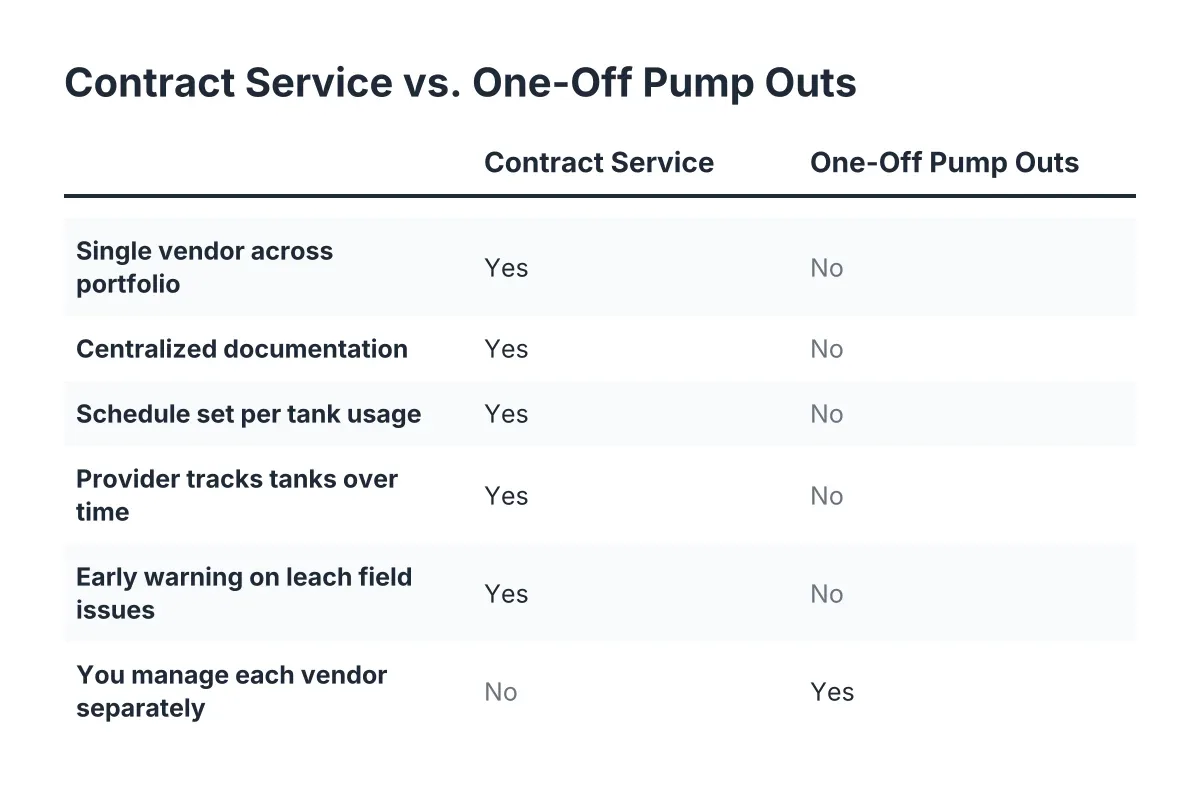
For property managers and HOA boards, the value of a single contract is one calendar, one invoice, and one vendor to chase. Ask how the provider batches routes across your addresses, and whether you can see the schedule in advance. Local providers who run Miami routes daily can often group your properties efficiently. A national dispatcher assigning work across subcontractors usually cannot.
4. What happens when something is wrong?
Routine pumping visits are where problems get caught early: a crushed inlet baffle, a saturated leach field, a grease trap past its capacity. Ask each provider how findings get flagged, who calls you, and how repair quotes work. Be cautious with any contract that pushes additives as a substitute for pumping; commercial septic additives marketed to dissolve sludge lack strong scientific backing, according to research from Washington State University Extension.
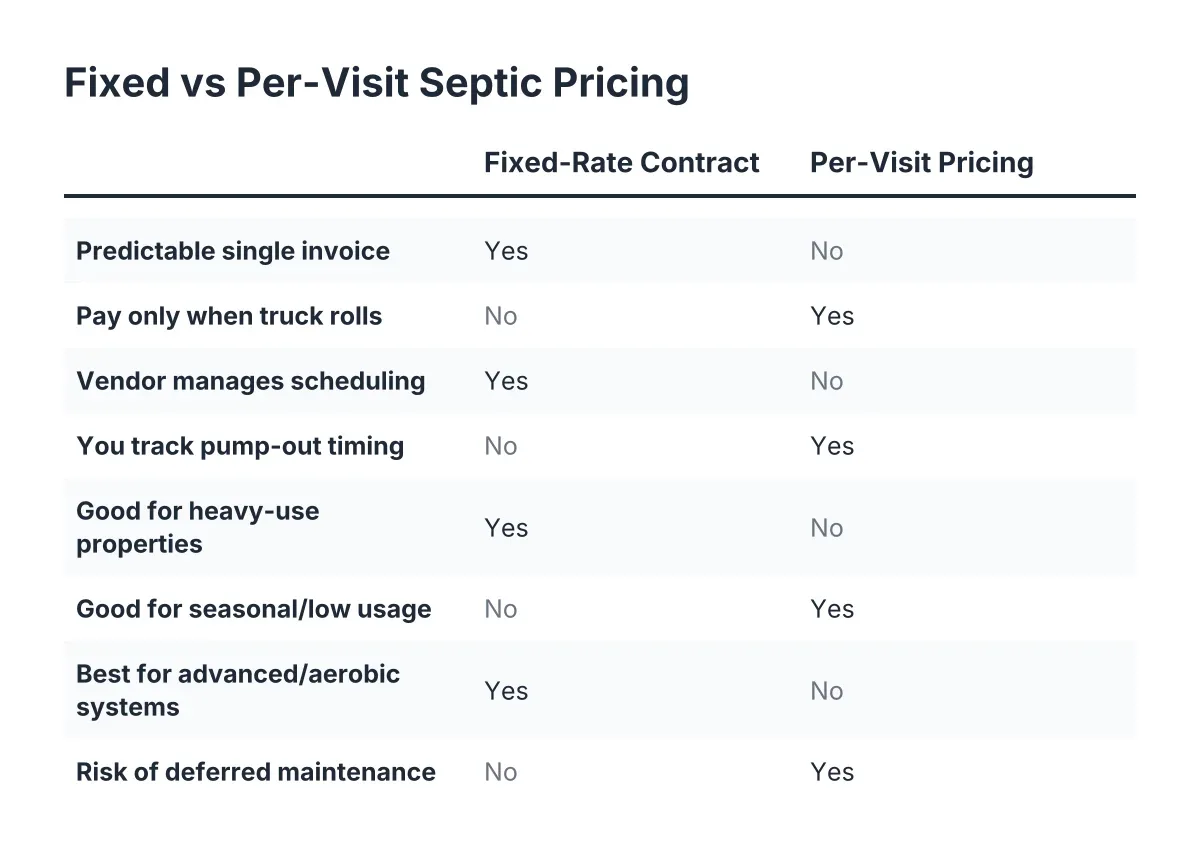
5. How is pricing structured?
You do not need the cheapest line item. You need predictable annual cost and no surprise charges. Ask what triggers an extra fee: heavier-than-expected sludge, a buried lid, an access problem, or a trap that needs a second pass. Local pump out pricing reflects local supply and demand, so a Miami quote from a Miami company usually tracks reality better than a national rate sheet built for every metro at once.
6. Who holds the compliance risk?
For restaurant operators, this is the deciding question. If a grease trap overflows or a county deadline gets missed, the fine lands on you, not the vendor. Compare contracts on how clearly they assign responsibility for scheduling, reminders, and record retention. The best answer is a provider who tracks your service cycle for you and keeps duplicate records you can request any time.
Where Local vs. National Septic Service Providers Tend to Win
Local knowledge is not a slogan in this trade; it is operational. Miami sits on porous ground with a high water table, heavy summer rains, and hurricane season flooding that can swamp drain fields. Flooded septic systems must be professionally cleaned, according to University of Florida IFAS, which notes that about 30% of Florida residents rely on septic systems. A local crew has worked through those wet-season conditions and plans routes and schedules around them.
Regulatory context matters too. Miami-Dade County's sanitary sewer system operates under a Federal Court Order to correct existing problems and reduce untreated sewage releases into the environment, according to Miami-Dade County. That pressure trickles down to septic and grease trap oversight across the county. A provider who works these permits and reporting requirements weekly will navigate them faster than a call center three time zones away.
In addition, local providers offer accountability you can verify. You can ask a neighboring restaurant who cleans their trap. You can check whether the company answers its own phone. Additionally, you can meet the person who will sign your service reports. None of that is possible with an aggregator site that treats Miami like every other metro.
Where National Chains Have a Case
Fairness requires the other side. National providers can make sense in narrow situations, and knowing them sharpens your comparison.
First, if your portfolio spans multiple states, a single national account can simplify billing across regions where no one local company operates. Second, some national firms offer online portals for service records, which appeals to larger management companies with reporting software requirements. Third, franchise operations sometimes bring standardized training that a thin, neglected local shop cannot match.
However, notice the pattern: every national advantage is administrative, not operational. The truck, the crew, and the disposal run are always local. When you sign national, you pay an administrative markup for coordination you could often do yourself with one good Miami-area provider and a shared spreadsheet. For a portfolio concentrated in Miami-Dade, the national case is thin.
A Scenario: Three Restaurants, One Contract Decision
Suppose you manage three restaurants, one in Miami Beach, one in Coral Gables, and one in Little Havana, each with a grease trap on a quarterly county compliance cycle. Say you get two proposals. The national chain quotes a flat per-visit rate, handles scheduling through a call center, and emails a generic receipt after each service. The local provider quotes a similar annual total, assigns your three locations to one route, and delivers a per-visit report showing gallons removed, trap condition, and the disposal facility used.
Six months in, imagine a health inspector asks the Coral Gables location for proof of grease trap service. With the local contract, the manager pulls the last two reports from a folder, and the inspection moves on. With the generic receipt, you are on the phone with a national help desk asking which subcontractor serviced the trap in March. In that scenario, the contracts cost about the same. The documentation did not.
The same logic applies if you are selling a septic-served commercial property or a home. A buyer's inspector who sees a documented septic service history with dated pump out reports treats the system as maintained. A seller with no records invites a deeper inspection, a repair credit demand, or a delayed closing. If you are heading toward a sale, a septic system inspection with a written report is worth arranging before the buyer's side forces the timing.
What Recurring Service Should Cost You Over Time
No honest article can quote your price without seeing your tanks and traps, and this one will not try. What the numbers do show is the shape of the trade-off. The U.S. Environmental Protection Agency notes that regular septic maintenance running $250 to $500 every three to five years is a bargain compared to repairing or replacing a failed system, which can cost $5,000 to $15,000. Commercial systems and grease traps run on faster cycles and higher volumes, so the figures differ, but the ratio holds: routine service is cheap insurance against a five-figure failure.
Therefore, when you compare commercial septic contracts on price, compare annual totals and what they buy, not per-visit rates alone. A slightly higher visit rate that includes filter cleaning, condition notes, and complete records usually beats a bare pump out that leaves you managing compliance alone. As of 2026, with disposal and compliance costs rising across South Florida, the gap between a documented service and a receipt-only service matters more each year.
When to Handle It Yourself and When to Call a Professional
Some tasks belong to you or your kitchen staff. You can scrape and wipe grease from cookware before washing, keep fats and oils out of drains, log what your crew observes around tank lids and drain fields, and keep your service records organized. Those habits stretch the time between cleanings and make every professional visit faster.
Everything involving the tank itself belongs to a professional. Septic tank pumping, tank cleaning, grease trap clean out, filter cleaning, and any leach field repair require equipment, disposal access, and trained crews. Tanks hold gases that can kill within minutes; no operator or property manager should ever open and enter one. Call a professional now if you notice sewage odors indoors or near the tank, slow drains across multiple fixtures, standing water or unusually green grass over the leach field, or grease trap backup into kitchen floor drains.
One honest limitation: a service contract covers maintenance, not miracles. If a system is undersized for a restaurant's volume, or a leach field is failing from age or saturation, no pumping schedule fixes the underlying problem. In those cases you need a septic system inspection and possibly design work from a licensed installer, which is a separate specialty; becoming a licensed installer requires certification covering soil types, percolation rates, and system design, according to the New Hampshire Department of Environmental Services. A good contract provider will tell you when you have crossed from maintenance into repair, not keep pumping and cashing checks.
Making the Final Call on Your Contract
Pull it together with three closing questions for any provider on your shortlist. First, can you show me a sample service report and tell me where the waste goes? Second, who exactly services my properties, and does that change month to month? Third, what is in the base contract, and what triggers an extra charge? A provider who answers all three plainly, in writing, has already outperformed most of the market.
A fair quote for a Miami-area commercial contract lists each property, each tank or trap, the service frequency, the documentation you receive, and the total annual cost. It does not bury exclusions in fine print or quote a teaser rate that grows after the first visit. If a national account manager and a local operator both hit that standard, weigh who you can actually reach when a trap overflows on a Friday.
For restaurant operators, HOA boards, and property managers across Miami, FL and surrounding areas, the practical move is simple. Get a local proposal on the table next to any national offer, and judge them on documentation, accountability, and the person behind the phone number. If you are ready to set up recurring septic tank pumping, grease trap cleaning, or a multi-property service plan, reach out to a local Miami-area septic provider for an estimate. One conversation about your properties and your compliance calendar will tell you more than any national sales page.
If you need septic tank pumping, Miami Septic Tanks can help.
Prefer to talk it through? Call (786) 756-8032 — a quick call is usually the fastest way to get a straight answer for your situation.