What’s Included in a Commercial Septic Contract vs. Optional Add-Ons
If you manage a portfolio of septic-served properties in the Miami area, you already know a one-off pump out here and there is not a plan. What you need is a recurring service agreement that covers the routine work, documents everything, and keeps liability off your desk. This guide breaks down what commercial septic contracts typically cover as standard—establishing a solid septic contract scope portfolio as the foundation for reliable maintenance—what shows up as an optional add-on, and how to structure the agreement so it actually protects your properties instead of just billing them.
The distinction matters more than most vendors let on. A contract that looks cheap often looks cheap because it leaves out the work you will need anyway. A contract that looks expensive may be bundling services half your properties do not use. Knowing which line items belong in the core agreement, and which ones you should price separately, is how you compare bids fairly and avoid mid-year surprises.
Why Portfolio Managers Need a Contract, Not a Call List
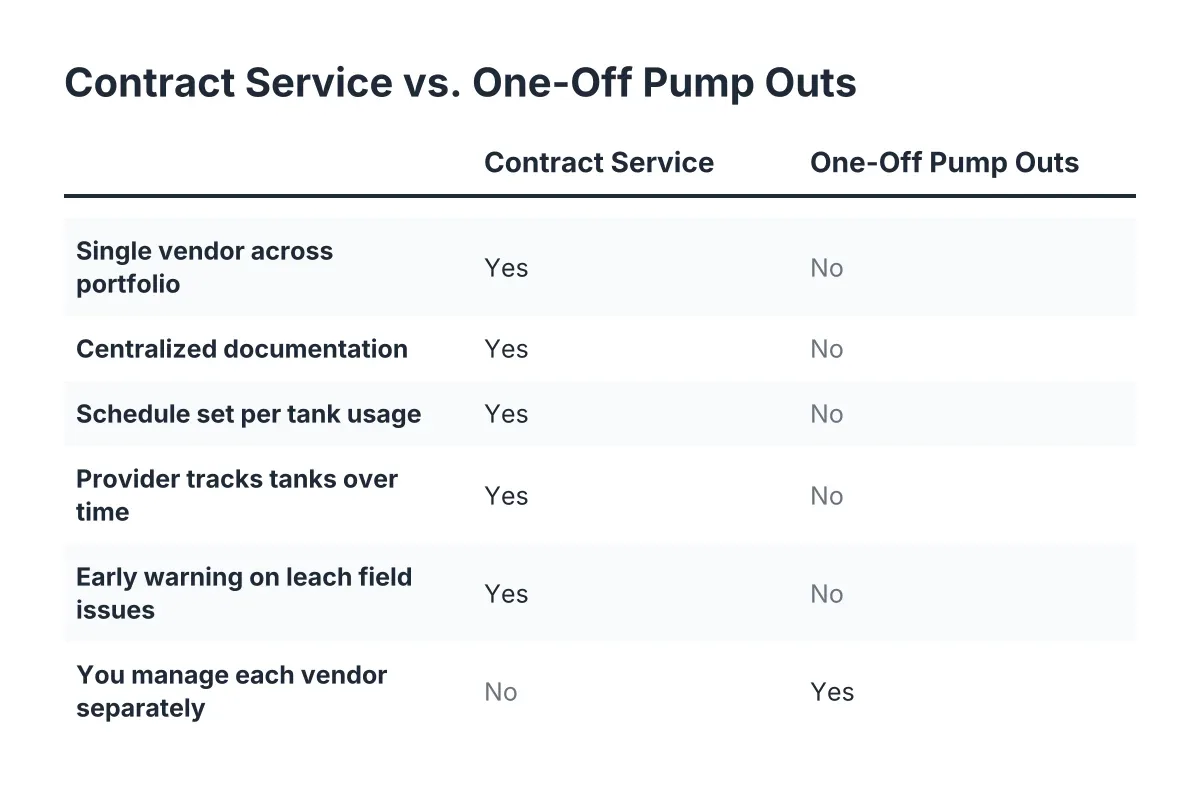
A property manager overseeing 5 to 50 septic-served units cannot run maintenance off a sticky note that says "call the septic guy." Every tank on your portfolio has its own pumping schedule, its own service history, and its own risk profile. A recurring contract turns that scattered work into one vendor relationship, one invoice trail, and one set of records you can hand to an insurer, a board, or a buyer's attorney.
The documentation piece is the part homeowner-focused advice skips. When a tenant complaint escalates, or an HOA board asks why a leach field failed, "we pumped it at some point" does not hold up. A documented septic service history, dated and tied to each property address, is what shifts the conversation from blame to record.
Scale matters here too. Miami Waterkeeper reports there are about 120,000 septic systems in Miami-Dade County across residential and commercial areas. Many of those sit under multifamily buildings, small commercial plazas, and HOA communities where the owner of record is a management company, not a resident. If that is you, the contract is your compliance paper trail, not just a maintenance convenience.
There is also a cost logic to routine service. According to the U.S. Environmental Protection Agency, regular septic maintenance runs about $250 to $500 every three to five years per system, while repairing or replacing a failed system can cost between $5,000 and $15,000. Multiply that gap across a 20-property portfolio and the case for a maintenance contract makes itself.
What's Included in a Septic Contract Scope for Commercial Properties
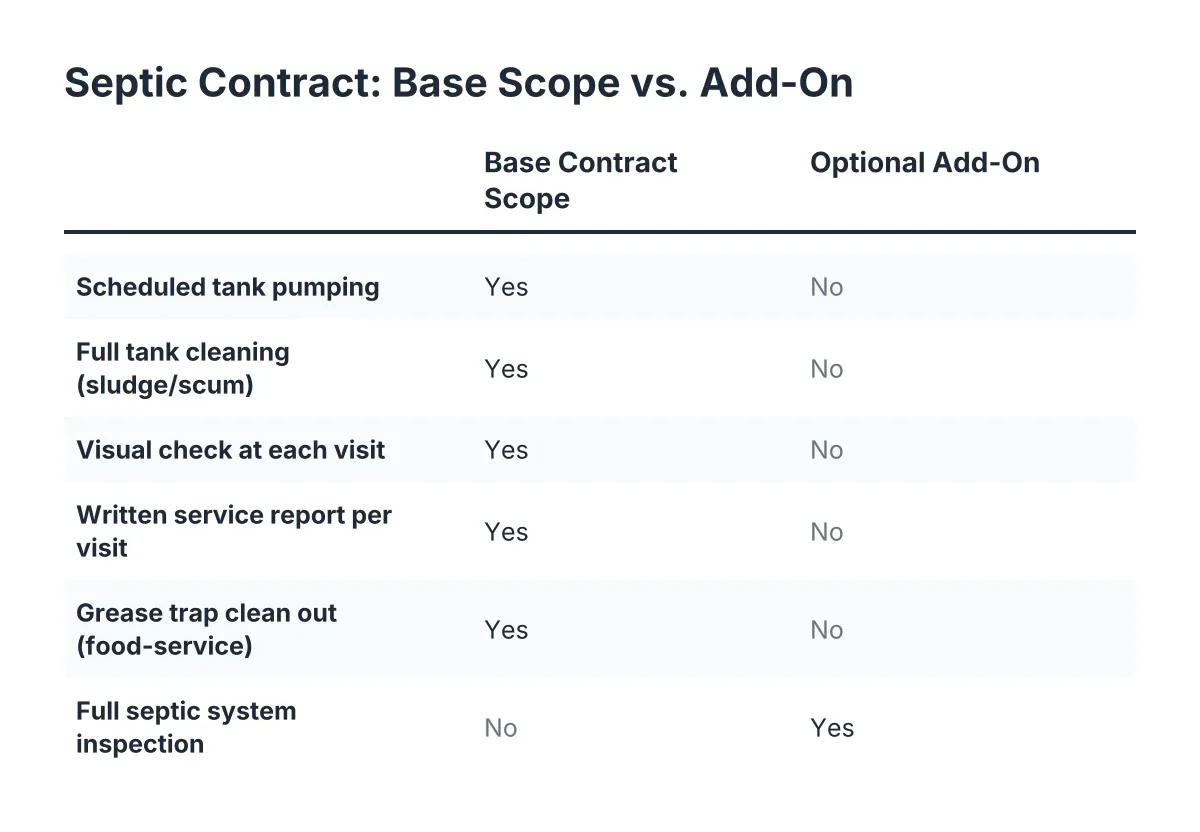
A standard commercial septic contract covers scheduled septic tank pumping, tank cleaning, a visual system check at each visit, and written service records for every property on the agreement. Grease trap clean out is standard for properties with food service. Anything beyond routine emptying, cleaning, and inspection usually falls into add-on territory.
Here is what you should expect to see in the base scope, line by line.
Scheduled Septic Tank Pumping and Pump Outs
The core of any agreement is scheduled septic tank pumping. The vendor pumps each tank on a set interval based on tank size, occupancy, and usage. A fully occupied 12-unit building fills a tank faster than a duplex, so a good contract sets intervals per property, not one blanket schedule for the whole portfolio.
The EPA recommends pumping most tanks every 3 to 5 years, but commercial and multifamily properties often need shorter intervals because more people means more wastewater. Your contract should name the interval for each address. If a vendor proposes the same interval for a 4-unit building and a 30-unit building, ask why.
Septic Tank Cleaning, Not Just Emptying
Pumping removes the liquid and floating layer. Septic tank cleaning goes further; the crew removes the settled sludge and scum stuck to the tank walls and baffles. This matters because leftover sludge shortens the time until the next pump out and can push solids toward the leach field, which is the expensive part of the system.
Confirm the contract language says cleaning, not just pump out. Some septic pump out companies quote a low per-visit rate that covers a quick empty and nothing else. On a portfolio contract, you want the full septic system cleaning each visit so intervals hold.
A Visual Check and Written Report at Every Visit
Every service visit should include a look at the tank condition, baffles, inlet and outlet, and any visible signs of trouble at the surface, such as wet spots or odors near the leach field. This is not a full septic system inspection; it is the technician flagging what they can see while the tank is open.
The written report is the deliverable that makes this worth paying for. Each visit should generate a dated record per property that states what was pumped, what was observed, and what was recommended. Over a year, those reports become the documented septic service history that protects you when a property sells or an insurance question comes up.
Grease Trap Clean Out for Food-Service Properties
If your portfolio includes a mixed-use building with a restaurant, café, or commercial kitchen, grease trap cleaning belongs in the base contract for that address. Grease traps fill much faster than septic tanks, often needing service every one to three months. Skipping them leads to backups, odor complaints, and code trouble that lands on the property manager first.
A single-vendor setup helps here. One company handling both the septic tanks and the grease trap clean outs across your properties means one schedule, one invoice, and one service log instead of chasing two vendors for the same building.
What Counts as an Optional Add-On, and When to Buy It
Add-ons are the services you need sometimes, at some properties, rather than everywhere on a fixed schedule. The smart move is not to reject them; it is to price them in the contract now, at agreed rates, so a mid-year problem does not turn into an open-ended invoice.
The common add-ons look like this:
- Full septic system inspection. A deeper evaluation than the per-visit check, often including flow testing and a look at the drain field. Useful before a sale, after a tenant complaint, or when a property changes use.
- Septic tank filter cleaning. Tanks with outlet filters need septic system filter cleaning between pump outs. If your tanks have filters, negotiate this into the base scope; if only some do, keep it as a priced add-on per address.
- Leach field repair. Drain field work is never routine. It is diagnosed case by case, so contracts price it separately, usually with an agreed diagnostic rate and a repair estimate process.
- Unscheduled pump outs. A holiday weekend at a fully booked rental property can overload a tank ahead of schedule. The contract should state the per-visit rate for off-cycle service so you are not negotiating during a backup.
- Real estate transaction inspections. When a property in your portfolio goes under contract, the buyer's side often requires a septic inspection for the home sale. Having your existing vendor handle it, with the full service history in hand, is faster than bringing in a stranger.
- Repair coordination. Some agreements include referrals or coordination with septic system repair contractors for work beyond pumping and cleaning, such as baffle replacement or pipe repair.
The trade-off is real: bundling every add-on into the base price inflates your annual cost for services most properties will not use in a given year. Leaving them all out means every problem becomes a change order. The middle path is a base contract for the routine work plus a rate sheet for the add-ons, agreed up front.
What's Included in Commercial Septic Pricing Structures
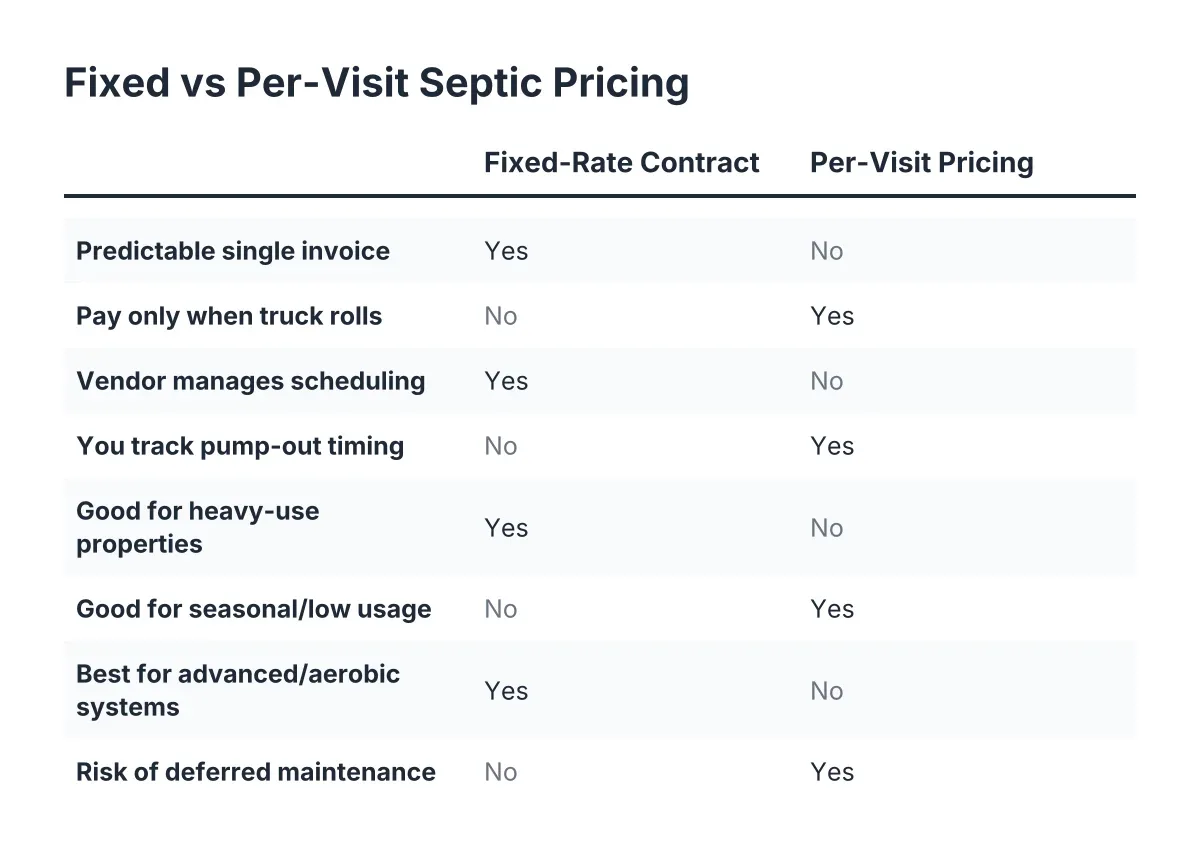
Commercial septic pricing under a contract usually follows one of three structures: per-visit rates on a set schedule, a flat annual fee per property, or a portfolio-wide annual agreement covering all addresses. Each structure includes the same core work; the difference is how the billing spreads across the year and across properties.
Per-visit pricing is the simplest to audit. You pay for each pump out or cleaning as it happens, at contract rates. It suits smaller portfolios where service is infrequent, but it makes annual budgeting lumpy.
Flat annual pricing per property smooths the budget. The vendor averages the expected visits into one yearly figure per address. This works well for HOA boards that need a fixed line item to present at budget meetings.
Portfolio agreements price everything under one umbrella number, often with a discount for volume and route efficiency; a crew servicing six of your properties in one Miami-area neighborhood spends less on travel than six separate one-off calls. Whichever structure you pick, insist the contract itemizes what each visit includes so "pumping" cannot quietly shrink to "partial pump out." A separate piece in this series covers what commercial septic contracts cost in more detail; this article stays focused on scope.
The Documentation Clause: The Part That Protects You
For a property manager, the paperwork is not an afterthought; it is half the product. Your contract should spell out exactly what records you receive, in what format, and how fast after each visit. Push for these minimums:
- A dated service report per property per visit, stating work performed and tank condition.
- Photos when the technician flags a problem, such as a damaged baffle or standing water over the leach field.
- A running service log per address you can export or forward, so a full documented septic service history travels with the property.
- Written recommendations with a stated urgency level, so you can tell a "watch this" from a "fix this now."
- Records that clearly identify the property address and date, in a format an insurer, attorney, or buyer's inspector will accept.
This clause earns its keep the day a property sells. Suppose an HOA you manage lists a unit, and the buyer's lender requires proof of septic maintenance before closing. In that scenario, a manager with a contract pulls three years of dated pump out reports in one email. A manager without one is calling around asking whether anyone remembers when the tank was last serviced, while the closing date slides.
There is a bigger reason regulators care about these records. The Florida Department of Environmental Protection notes that well-maintained septic systems help protect the groundwater that supplies 90% of Florida's drinking water. Documentation shows your properties are part of the solution, not the problem, and that posture matters if a county inspector ever comes asking.
How Commercial Septic Contracts Compare to Homeowner Service
A commercial septic contract differs from homeowner service in schedule, scope, and paperwork. Homeowners call a septic cleaner near them when a problem shows up; a contract puts every tank on a calendar before problems start. The service itself, pumping and cleaning a tank, is similar; everything wrapped around it is not.
Three differences matter most for a portfolio:
First, the schedule is proactive. The EPA recommends inspecting a septic system every 1 to 3 years and pumping every 3 to 5, and a contract enforces those intervals automatically across every address. No property falls through the cracks because a site manager changed jobs.
Second, the scope covers commercial realities. Grease trap cleaning, sewer tank service for larger buildings, and higher-frequency pump outs for high-occupancy properties all belong in commercial scope and rarely appear in residential offerings.
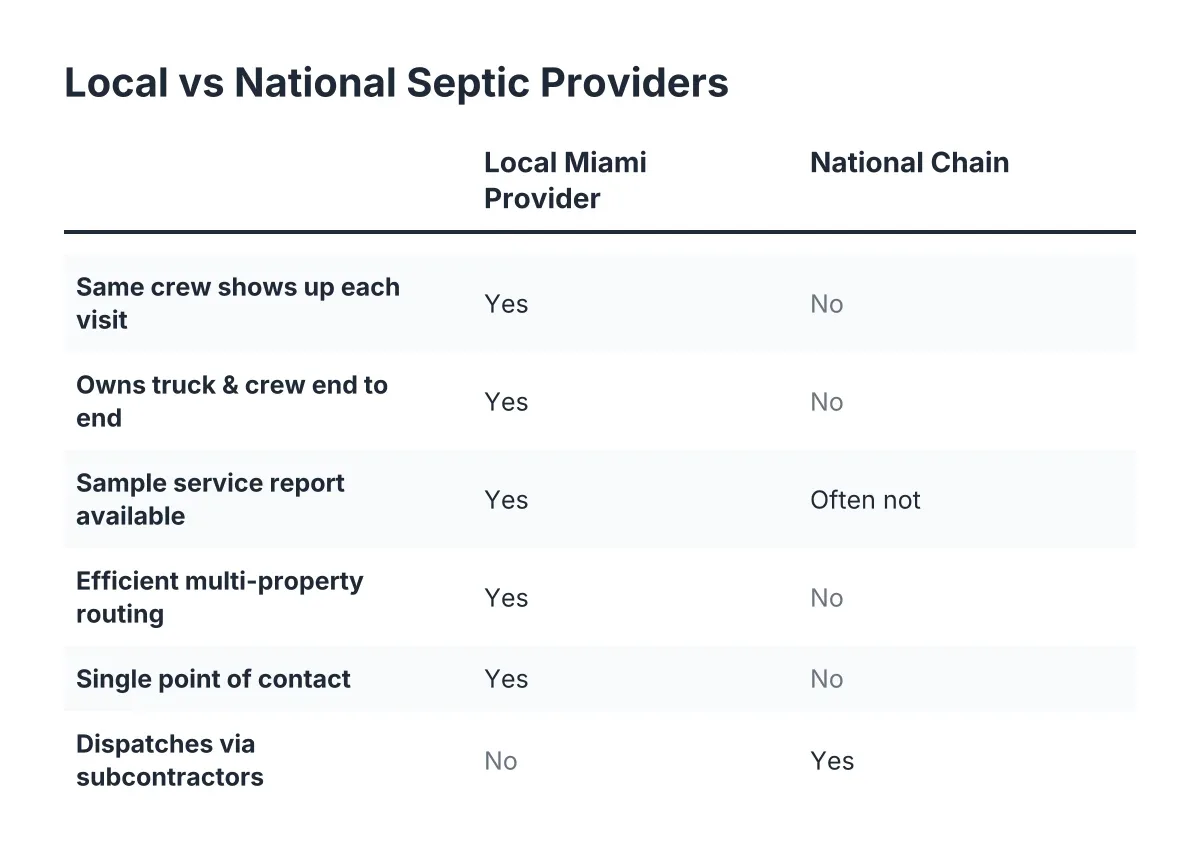
Third, the relationship survives turnover. Tenants move, site managers rotate, and board members term out. The contract, and the service history attached to it, stays with the management company. That continuity is what makes single-vendor convenience more than a nice phrase; it is the reason the same crew that knows your tank locations shows up year after year.
A Simple Checklist Before You Sign
Before you sign any agreement, walk through the scope with the vendor property by property. Here is a working checklist:
- Does the contract list every property address with its own pumping and cleaning interval?
- Does "pumping" include full tank cleaning, or just emptying?
- Are grease trap clean outs included for every food-service address?
- Is septic tank filter cleaning covered where tanks have filters?
- Are add-on rates for inspections, off-cycle pump outs, and leach field diagnostics written into the contract?
- What documentation do you receive per visit, and how quickly?
- How does the vendor handle a property that sells or leaves your portfolio mid-term?
- Who do they refer to, or coordinate with, for repair work beyond pumping and cleaning?
One honest caveat: a service contract covers maintenance, not engineering. If a system shows repeated backups, drain field failure, or capacity problems from a change in building use, you need a full evaluation by a qualified septic professional, and possibly a county-permitted repair, before any contract schedule will help. A good local vendor will tell you that plainly instead of pumping a failing tank every month and billing you for it.
Getting the Most From the Agreement in Year One
Once you sign, treat the first year as the calibration year. The initial pump out at each property tells the crew how full each tank actually was, and that data should adjust the intervals going forward. A tank that was near capacity at month 18 needs a shorter cycle; a tank barely a third full at month 36 can stretch.
In addition, use the first-year reports to build your risk map. Flag any property where the technician noted baffle wear, slow drainage, or surface wetness near the leach field. Those are the addresses to budget repair reserves for in 2026, before they become emergencies.
Finally, put the service log where your team can find it. When a leasing agent gets a septic question from a prospective buyer, or a board member asks what the maintenance line item bought last year, the answer should be one attachment away. That is the real return on a well-scoped contract: routine work done on time, and proof of it whenever anyone asks.
If you need septic tank pumping, Miami Septic Tanks can help.
Prefer to talk it through? Call (786) 756-8032 — a quick call is usually the fastest way to get a straight answer for your situation.