Septic Tank Pumping Frequency: How Often Miami Homes and Businesses Need Service
If you own a home or run a business in the Miami area, septic tank pumping frequency is one of those things you probably don't think about until something goes wrong. A slow drain, a bad smell near the tank, or a health inspector asking for service records will get your attention fast. The confusing part is that when you start searching, you find "pumping," "cleaning," and "pump out" used like they all mean the same thing. Sometimes they do. Sometimes they don't. This guide explains the difference, how often Miami properties actually need service, and how to pick a provider who does the full job instead of the quick one.
Pumping vs. Cleaning: What You're Actually Paying For
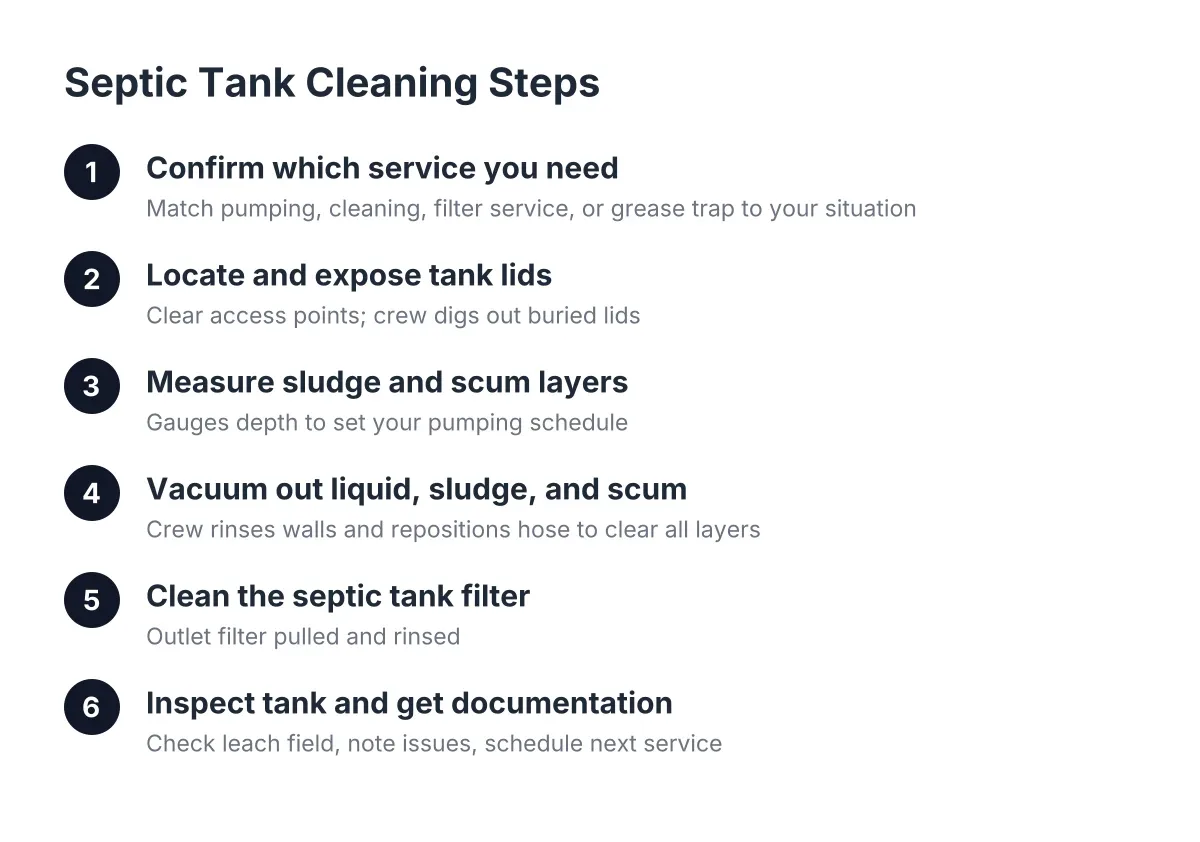
Here is the short version. Septic tank pumping removes the liquid and floating waste from your tank. Septic tank cleaning removes everything, including the thick sludge packed on the bottom. Many companies use the words interchangeably, which is how people end up paying for a partial job and wondering why problems come back.
A pump out is the routine service. A truck arrives, a hose goes into the tank, and the liquid contents get vacuumed out. It's faster and cheaper, and for a tank on a regular schedule, it's often all you need.
Full septic tank cleaning goes further. The technician pumps the liquid, then breaks up and removes the compacted sludge layer at the bottom of the tank. That sludge is the stuff that builds for years. If it never gets removed, it slowly steals capacity from your tank. A 1,000 gallon tank with a foot of hardened sludge is not really a 1,000 gallon tank anymore.
So which one do you need? Ask yourself when the tank was last serviced. If it's been on a steady schedule, a standard pump out usually covers it. If it's been five or more years, or you don't know the history, ask for a full cleaning and have the tech tell you what they find. A good local septic tank cleaner will look at the sludge depth and tell you straight whether pumping alone is enough.
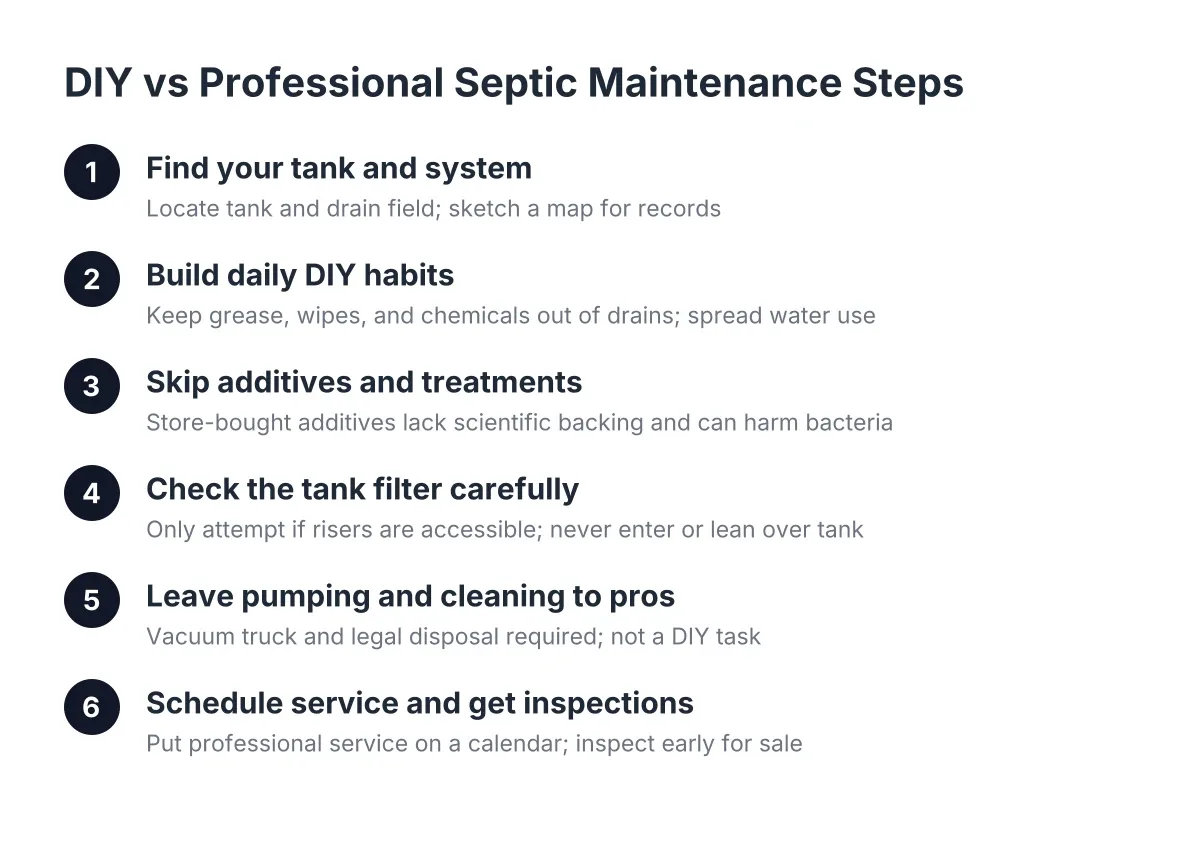
One more term worth knowing: septic tank filter cleaning. Many tanks have an outlet filter that keeps solids from escaping into the leach field. It needs cleaning too, and it's a quick add-on during a pump out. A clogged filter causes slow drains that look exactly like a full tank.
How Often to Schedule Septic Tank Pumping in Miami
Most Miami-area septic tanks need pumping every three to five years, and busier households or businesses need it more often. According to University of Florida IFAS, tanks should be pumped every three to five years to stay in working order, and a well-maintained septic tank can last up to 30 years.
The U.S. Environmental Protection Agency gives similar guidance: inspect the whole system every 1 to 3 years and pump the tank every 3 to 5 years. Those are national numbers, though, and South Florida has a few conditions that push most properties toward the shorter end of that range.
First, our water table is high. When the ground around your tank and leach field is saturated, the soil can't absorb wastewater as fast. A tank running near capacity has less room for error. Second, heavy rainy seasons and storm flooding stress systems here in ways they don't in drier states. University of Florida IFAS notes that about 2 million Florida homes, about 30% of the state's residents, rely on septic systems, and flooded systems must be professionally cleaned before they go back into normal use.
This is not a small local issue. Miami Waterkeeper estimates that roughly 120,000 septic systems operate in Miami-Dade County across residential and commercial areas. A lot of your neighbors are on the same clock you are.
What Changes Your Septic Tank Pumping Frequency
No single schedule fits every property. Four things drive how fast your tank fills, and knowing them lets you set a realistic interval instead of guessing.
- Tank size. A 1,000 gallon septic tank serving a small household might go four or five years between pump outs. The same tank serving a large family fills much faster.
- Number of people. More people means more wastewater and more solids. This is the biggest single factor.
- What goes down the drain. Garbage disposals, grease, wipes, and heavy laundry loads all speed up sludge buildup.
- System age and condition. Older tanks and tired leach fields have less margin, so a tighter schedule protects them.
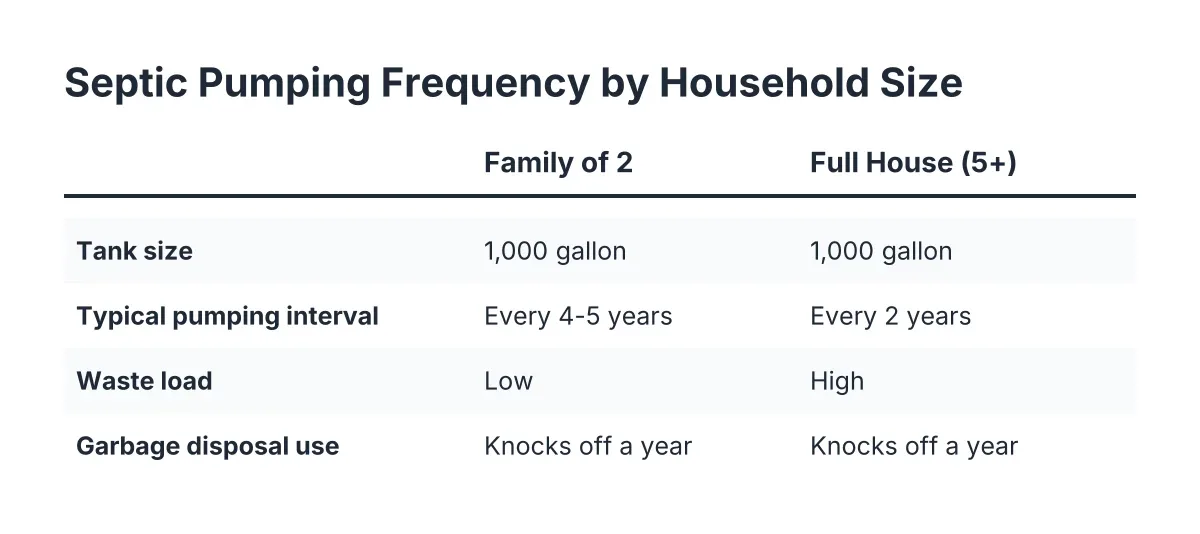
As a working rule of thumb for the Miami area: a family of 2 in a home with a 1,000 gallon tank can often stretch to every 4 to 5 years. A family of four or five in the same house should plan on every 2 to 3 years. A home with a garbage disposal that gets daily use should knock a year off whatever interval it would otherwise follow.
If your property has a holding tank rather than a full septic system, none of this applies. Holding tanks have no drain field; everything stays in the tank until it's pumped. Holding tank pumping frequency runs on weeks or months, not years, depending entirely on water use.
How Often to Pump for a Family of 2 vs. a Full House
A family of 2 with a standard 1,000 gallon tank can usually pump every four to five years, while a household of five or more often needs service every two years. The tank doesn't care about the calendar; it cares about gallons and solids.
For example, two retirees who cook lightly and run laundry twice a week put a fraction of the load on a system that a family with three teenagers does. Same tank, same street, but one owner pumps twice a decade and the other pumps twice as often. When in doubt, have the sludge depth checked during an inspection and set your schedule from real measurements instead of averages.
Pumping Frequency for Restaurants and Commercial Kitchens
Commercial kitchens on septic need service far more often than homes, and the grease trap runs on its own separate schedule. If you operate a restaurant in the Miami area, you're managing two clocks, not one, and the grease trap clock ticks much faster.
A grease trap catches fats, oils, and grease before they reach your septic tank or sewer line. When it fills past capacity, grease pushes through to the tank or backs up into your kitchen drains. That's the slow, smelly floor drain during dinner rush. It's also what a health inspector flags, and a flagged trap can put your operating status at risk.
Grease trap clean out frequency depends on trap size and kitchen volume. A common industry benchmark is some version of the "25% rule": once fats, oils, and grease fill about a quarter of the trap's capacity, the trap is due for cleaning — though the exact threshold written into local codes varies. For a busy kitchen, that can mean monthly or quarterly grease trap cleaning. A low-volume café might stretch longer. Check your local code, because Miami-Dade enforces grease trap maintenance, and inspectors ask for service records.
Consider a hypothetical scenario: imagine a 60-seat restaurant near Kendall where drains start slowing on Friday nights. The manager assumes the septic tank is full and orders a pump out. The tank turns out fine; the grease trap is packed solid and grease has started migrating into the line. A grease trap clean out fixes the drains, but now the septic tank needs an earlier cleaning too, because grease accelerated the sludge buildup. In that scenario, one overdue trap turns into two services and a nervous week before an inspection.
Two practical points for operators. First, ask any vendor whether they can service the trap outside your service hours; a trap cleaning during lunch rush helps nobody. Second, keep every service receipt. Documented grease trap cleaning history is your proof when the inspector asks, and it's the fastest way to show a pattern of compliance.
Pumping Schedules for Property Managers and HOAs
If you manage multiple septic-served properties, the smart move is one documented schedule across the portfolio instead of reacting to each tenant complaint. Scattered one-off calls cost more, create gaps in records, and leave you exposed when a system fails between visits.
Multifamily buildings fill tanks faster than single-family homes because occupancy is higher and usage is constant. As a rule of thumb, a duplex or fourplex on a shared tank usually needs pumping more often — closer to every one to three years than every three to five. Turnover matters too; new tenants bring new habits, and nobody tells the property manager what's going down the drains.
Therefore, a portfolio approach usually looks like this:
- Inspect every septic-served property once to establish tank size, condition, and current sludge level.
- Set a per-property interval based on occupancy and tank size, not a blanket rule.
- Batch service dates so nearby properties get pumped in the same window, which is easier to schedule and often cheaper per visit.
- Keep a written service log per property for liability, insurance, and pre-sale inspections.
That last point earns its keep the day a unit sells or an insurance claim lands. A dated record showing regular septic system cleaning and pump outs is the difference between a routine question and an expensive dispute. Buyers' inspectors ask for it. So do some lenders.
The trade-off worth naming: a scheduled maintenance agreement costs money in years when nothing goes wrong. However, routine maintenance — typically a few hundred dollars every few years — is a bargain next to repairing or replacing a failed system, which can easily run into five figures once a leach field is involved. Spread across a portfolio, one avoided leach field repair pays for years of scheduled pump outs.
Warning Signs You've Waited Too Long
Slow drains throughout the building, sewage odors near the tank or drains, standing water over the leach field, and gurgling pipes are the four classic signs a septic tank is overdue for service. Any one of them means stop guessing and get the tank checked.
Watch for these specifically:
- Slow drains everywhere, not just one fixture. One slow sink is a clog. Every drain slow at once points to the tank or the outlet filter.
- Odors outside near the tank lid or inside near floor drains. Gases escaping means the tank is past capacity or the filter is blocked.
- Wet, spongy, or unusually green patches over the drain field. The leach field is receiving more than it can absorb.
- Gurgling in pipes after flushing or draining. Air is fighting wastewater for space in the line.
- Sewage backup at the lowest drain in the building. This is the last warning, not the first.
By the time you see backup, you're past routine maintenance and into damage control. Waiting also risks the expensive part of the system. The tank is a box; boxes get pumped and cleaned. The leach field is a network of pipes and soil, and once solids or grease push into it, leach field repair costs a multiple of any pump out you skipped.
One honest caveat: symptoms overlap. A blocked filter, a full tank, and a failing drain field can all show up as the same slow drain. This is a case where a professional inspection beats guessing, because the fixes range from a quick septic tank filter cleaning to a serious excavation, and you want to know which one you're facing before you spend.
Choosing a Local Provider Without the Runaround
When you search "septic cleaner near me" or "septic pump out companies," a lot of what comes back isn't local at all. National aggregator sites collect your call, sell it as a lead, and route it to whoever pays for it. You end up explaining your problem to a call center in another state that has never seen a Miami leach field.
For a job like this, local knowledge matters. A Miami-area provider knows the high water table, the rainy-season stress on drain fields, and the Miami-Dade rules around grease traps and septic permits. Those details change the advice you get and the schedule you should be on.
A few questions separate a real operator from a lead reseller:
- Will you pump only, or measure sludge and clean the full tank if it needs it? You want a provider who tells you which service the tank actually needs.
- Do you clean the outlet filter during a pump out? It's a small step that prevents a common callback.
- Can I get a written record of what was removed and the tank's condition? Restaurants need it for inspectors; property managers need it for files.
- Do you handle grease trap clean outs and septic on the same visit? For food service on septic, one vendor for both simplifies scheduling.
- Are you actually based in the Miami area? A direct answer here tells you a lot.
Septic pumping cost varies with tank size, access, and how much sludge has built up, so treat any quote given sight unseen with caution. A fair provider will explain what drives the price before the truck arrives, not after.
Putting Your Schedule on Paper
The whole point of understanding your septic tank pumping frequency is that it turns an emergency into an appointment. Homes in the Miami area should plan on every three to five years, tighter for big households. Multifamily properties should expect shorter intervals and keep records per building. Restaurants should run the grease trap on its own fast schedule, often monthly or quarterly, and never let inspection season arrive without receipts.
The core guidance from the EPA and University of Florida IFAS is consistent: regular pumping every three to five years, inspections every one to three, and a well-kept tank that lasts decades. Write your last service date down, set the next one based on your household or business load, and the system will stay the one part of the property you never have to think about during a dinner rush.
If you need septic tank pumping, Miami Septic Tanks can help.
Prefer to talk it through? Call (786) 756-8032 — a quick call is usually the fastest way to get a straight answer for your situation.