DIY Septic Tank Maintenance vs. Professional Cleaning: What You Can and Can’t Do Yourself
If you own a home on septic, or you are about to buy or sell one, you have probably wondered how much DIY septic tank maintenance you can handle yourself and when you need to call a pro. The answer matters more than most people realize. Some tasks are safe, cheap, and smart to do on your own. Others, like a full pump out or tank cleaning, need a truck, a trained crew, and a legal place to haul the waste.
This guide walks through the maintenance work step by step. For each step, you will see what a homeowner can do and where the line sits between do it yourself care and professional septic tank pumping or septic tank cleaning. If a closing date is riding on your septic system, this will also help you understand what an inspector looks for and what "cleaning" actually means on an invoice.
First, one quick clarification, because the terms confuse almost everyone. Pumping means removing the liquid and floating waste from the tank. Cleaning means removing everything, including the thick sludge stuck to the bottom and walls, often with water added to break it loose. When you compare septic pump out companies or search for a septic cleaner near me, make sure you know which service you are being quoted.
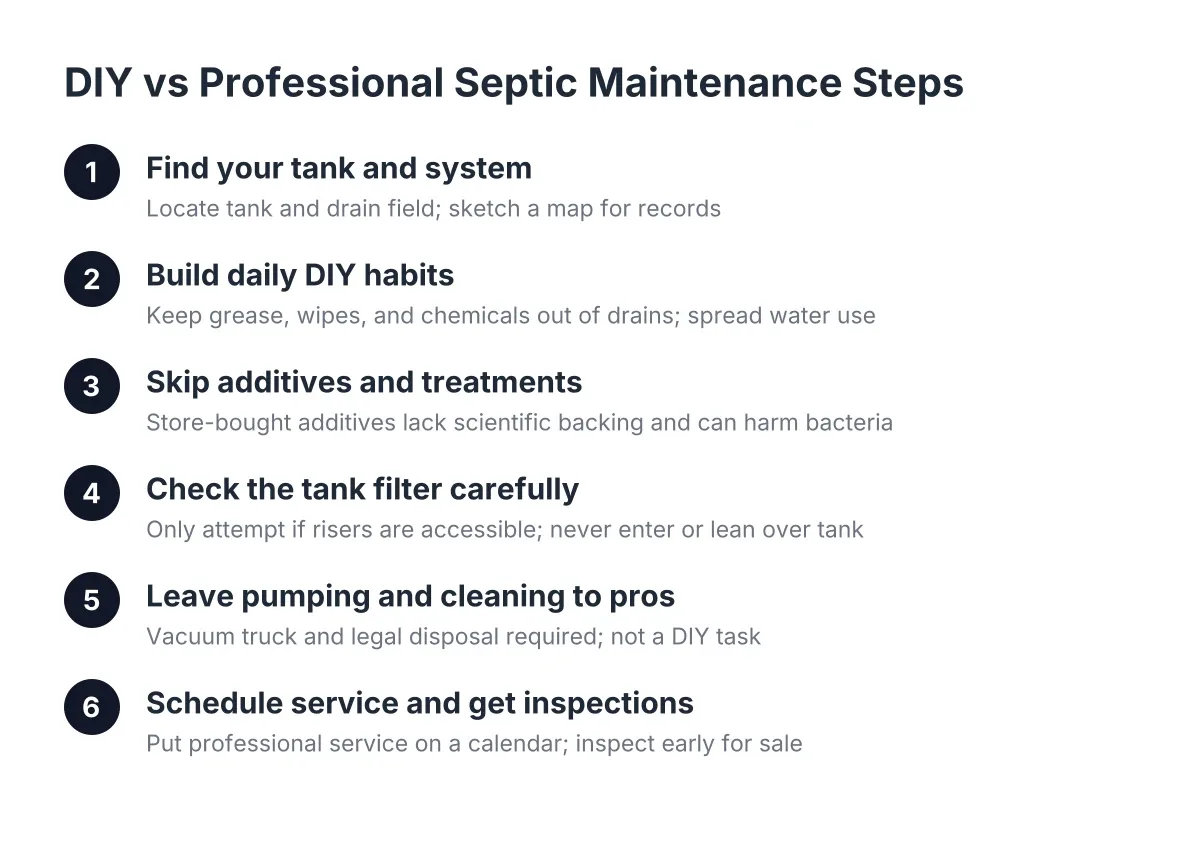
Step 1: Find Your Tank and Learn Your System
Start by locating your septic tank and drain field before anything else. You cannot maintain what you cannot find. According to the U.S. Environmental Protection Agency, a conventional septic system has two main parts: the septic tank, which lets solids settle out, and the drain field, which disperses the clarified liquid into the soil. Every drain in your house feeds into that one tank through a single pipe.
Check your property records or the county health department for a site plan showing the tank location. In older Miami-area neighborhoods like Coral Gables or Coconut Grove estate lots, tanks are often buried under decades of landscaping, so this step can take some digging, literally.
This step is fully DIY. Sketch a simple map, mark the tank lids and the drain field edges, and keep it with your home records. If you are selling, that map saves the inspector time and shows the buyer the system has been cared for.
Step 2: Daily DIY Septic Tank Maintenance Habits That Count
Next, control what goes down your drains, because this is the part of septic tank upkeep that has the biggest payoff. Your tank depends on bacteria to break down waste. Feed those bacteria wrong, and solids build up faster, which means more frequent pump outs.
Here is what to keep out of the system:
- Grease, cooking oil, and fat, which coat the tank and clog the leach field
- Wipes of any kind, even ones labeled flushable
- Coffee grounds, paper towels, and feminine products
- Harsh drain cleaners and large amounts of bleach
- Paint, solvents, and medications
In addition, spread out your water use. Running the dishwasher, washing machine, and showers all at once pushes water through the tank too fast, carrying solids into the drain field. A leach field damaged this way is one of the most expensive repairs in the septic world.
This step costs nothing and is entirely in your hands. No septic pump out companies can do it for you.
Step 3: Skip the Additives and Miracle Treatments
Now for the step where you save money by doing nothing. Store shelves are full of powders and liquids that promise to dissolve sludge so you never need a pump out. According to Washington State University Extension, commercial septic tank additives marketed to decompose or dissolve sludge lack strong scientific backing.
Worse, some cleaning treatments can kill the beneficial bacteria your tank needs, or corrode tank components. A tank is a living system. The safest approach is regular pumping on a schedule, not a monthly scoop of product. Homeowners who skip real maintenance and lean on additives tend to end up needing service more often, not less.
If you are mid-sale and the buyer's inspector finds a struggling system, an additive will not fix it before closing. Only a real pump out, cleaning, or repair will.
Step 4: Check the Tank Filter, Carefully
Many tanks built or retrofitted in recent decades have an effluent filter on the outlet. It catches solids before they reach the drain field, and it needs periodic cleaning. Some homeowners with accessible risers can pull and rinse the filter themselves, hosing it off over the open tank so debris falls back inside.
However, be honest about the risks. Locating and safely extracting a buried filter is harder than it sounds, and open septic tanks release gases that can knock a person out. Never lean over an open tank alone, and never climb in for any reason. If your lids are buried or you are unsure what you are looking at, this is where septic tank filter cleaning as a professional service earns its fee. A crew doing a routine septic system cleaning will check and clean the filter as part of the visit anyway.
Step 5: Know Why Pumping and Cleaning Are Not DIY Jobs
Here is the hard line. You cannot pump or clean your own septic tank, and searching for do-it-yourself septic tank pumping methods online will lead you toward trouble. Solids build up in every tank over time; bacteria alone cannot eliminate them. Removing that waste takes a vacuum truck, and according to the New Hampshire Department of Environmental Services, pumped septic waste must be trucked to a sewage treatment plant for disposal. There is no legal way for a homeowner to dispose of it.
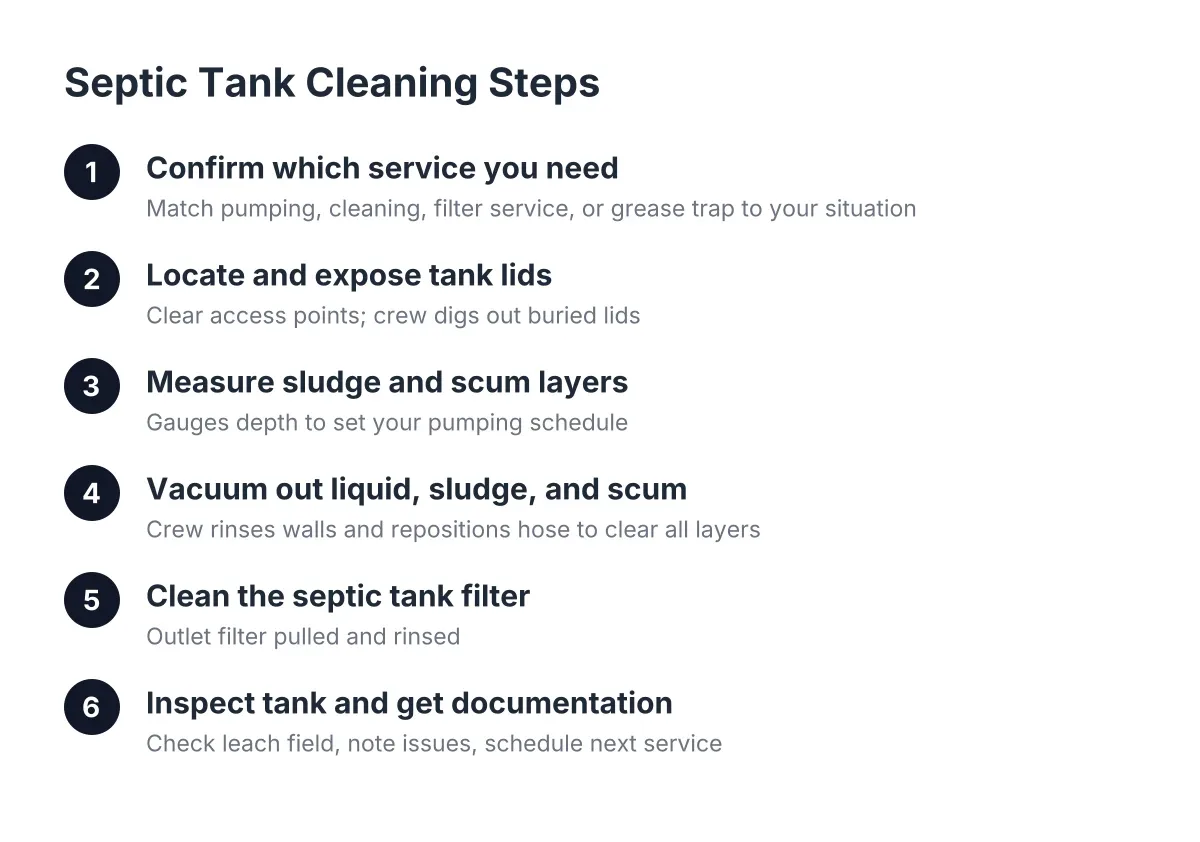
There is also a real difference between the two services, and it affects what you pay for. Pumping removes the liquid and floating layer. Cleaning goes further: the crew breaks up and removes the compacted sludge on the bottom, often rinsing the tank walls. If your tank has gone many years without service, ask for a full septic system cleaning, not just a pump out, so you are not paying twice.
The same logic applies to businesses. A restaurant on septic needs grease trap clean out service on its own schedule, separate from the tank, because grease is the fastest way to kill a system.
Step 6: Put Professional Service on a Calendar
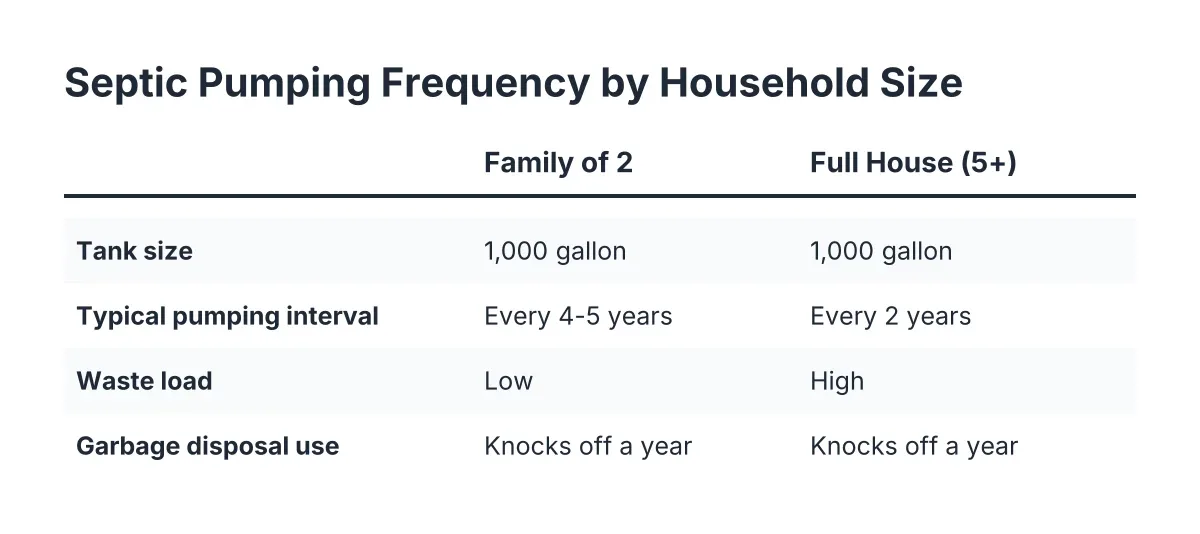
Treat pumping like an oil change, not an emergency. The U.S. Environmental Protection Agency recommends inspecting the entire septic system every 1 to 3 years and pumping the tank every 3 to 5 years. For an active family of four, Penn State Extension advises pumping every two to three years because of higher household water and solids.
The math favors the schedule. According to the U.S. Environmental Protection Agency, regular maintenance runs about $250 to $500 every three to five years, while repairing or replacing a failed system can cost $5,000 to $15,000. University of Florida IFAS notes that with proper maintenance, a septic tank can last up to 30 years. One more practical tip: since an inspection visit often costs close to a pump out, it usually makes sense to have the tank pumped during the same visit rather than pay for a look-only diagnosis.
Step 7: If You Are Buying or Selling, Get an Inspection Early
Suppose you are selling a 1970s home in the Miami area and your closing is six weeks out. The buyer's contract requires a septic inspection, and you have no record of the last pump out. In that scenario, waiting is the mistake. Schedule a septic system inspection now, with a pump out at the same visit, so the inspector can see the empty tank and check the baffles, filter, and leach field. If a problem like a saturated drain field turns up, you still have time to price leach field repair instead of scrambling the week of closing.
DIY septic tank maintenance cannot produce the documentation a real estate deal needs. Buyers, lenders, and agents want a service record from a local company, not a homeowner's word. Given that more than one in five U.S. households rely on septic systems, according to the U.S. Environmental Protection Agency, inspectors in septic-heavy areas see neglected tanks constantly and know the signs.
The Bottom Line: Split the Work Sensibly
Do the habits yourself: watch what you flush, spread out water use, protect the drain field from vehicles, and keep records. Leave the tank work to a local crew: pumping, full tank cleaning, filter service, inspections, and any leach field repair. That split keeps your costs low without gambling a $5,000 to $15,000 system on a bottle of additive or a skipped pump out.
If it has been more than three years since your last service, or you have never had one, start with a pump out and inspection from a local Miami-area provider. Everything else in this guide gets easier once you know what shape your tank is actually in.
If you need septic tank pumping, Miami Septic Tanks can help.
Prefer to talk it through? Call (786) 756-8032 — a quick call is usually the fastest way to get a straight answer for your situation.