Annual Septic Maintenance Costs: What Pumping, Cleaning, and Inspections Really Add Up To
If you run a restaurant or manage a property in the Miami area, annual septic maintenance costs probably feel like a moving target. One company quotes you a flat rate, another tacks on fees after the truck leaves, and a third tries to sell you a repair you never asked about. That uncertainty is the real problem. Most people are not afraid of paying for septic service. They are afraid of paying for the wrong thing, or paying twice.
This guide breaks the yearly picture into its actual parts: pumping, cleaning, filter service, inspections, and for commercial kitchens, grease trap clean outs. When you can see each line item and how often it should happen, the "hidden cost" anxiety mostly disappears. You can budget, compare quotes, and spot an upsell from across the room.
Why Septic Costs Feel Hidden When They Are Not
Septic pricing feels murky for a simple reason: the tank is underground. You cannot see what condition it is in, so you cannot easily tell whether a recommendation is honest or padded. A vendor says your tank "needs a full cleaning, not just a pump out," and you have no way to check.
The services themselves, however, are not mysterious. A residential or commercial septic system has two main parts, a tank and a drain field, according to the U.S. Environmental Protection Agency. Solids settle in the tank. Liquid flows out to the leach field, where the soil absorbs it. Nearly 25 percent of U.S. households, more than 26 million homes, rely on systems like this, according to Census Bureau data cited by EPA. That is a lot of tanks getting pumped on a schedule, and the work is routine for any competent local crew.
Therefore, the way to protect yourself is not to find the cheapest septic tank pumping quote in your inbox. It is to know what each service actually is, how often your system needs it, and which combinations save money. That is what the rest of this guide covers.
The Four Line Items Behind Annual Septic Maintenance Costs
Every dollar you spend on septic maintenance in a given year falls into one of four buckets. Once you see them separated, comparing quotes gets much easier.
- Pumping (pump out). A truck removes the solids and liquid from your tank and hauls the waste to a treatment plant. Pumped septic waste goes to a sewage treatment facility for disposal, according to the New Hampshire Department of Environmental Services; it is not processed on your property. This is the core service, and the one most people mean when they search "septic cleaner near me."
- Cleaning. A step beyond pumping. The crew removes the sludge layer stuck to the tank walls and bottom, not just the liquid on top. Some septic pump out companies quote "pumping" but only skim the liquid, then charge extra for the sludge. Ask which one you are getting before the truck arrives.
- Filter cleaning. Many tanks have an outlet filter that keeps solids from washing into the leach field. Septic tank filter cleaning is quick and cheap compared to the leach field repair it prevents. It should be checked at every pump out.
- Inspection. A trained eye checks the tank, baffles, filter, and drain field for corrosion, root intrusion, and early signs of failure. EPA recommends inspecting the entire septic system every 1 to 3 years as part of regular maintenance.
For restaurants and commercial kitchens, there is a fifth line item: the grease trap clean out. More on that below, because it runs on its own schedule and its own compliance clock.
How Often Each Service Should Happen
Frequency drives your yearly total more than any single quote does. Pay for the right service at the right interval and the math stays small. Skip intervals and the math gets ugly fast.
When to Pump a Septic Tank
Most septic tanks need pumping every three to five years, according to University of Florida IFAS, and with proper maintenance a tank can last up to 30 years. For a busy household, the interval shortens. Penn State Extension notes that an active family of four generally does better pumping every two to three years, because more people means more solids.
Commercial properties run harder still. A restaurant, cafe, or small hotel pushes far more water and waste through its system than a home does. If your business sits on a septic system, plan on the short end of every schedule you read, and let usage, not the calendar alone, set the interval.
Signs you have waited too long include slow drains throughout the building, gurgling sounds, sewage odors near the tank or leach field, and wet spots in the yard. If you are seeing those, you are past "when to pump septic tank" and into "call someone today" territory.
Inspections: Pay Once, Not Twice
Here is a budgeting trick worth remembering. An inspection-only visit often costs close to what a pump out costs, because the truck, the crew, and the dig time are the same. Therefore, the smart move is usually to combine them. Have the tank pumped and inspected in the same visit. You pay for one trip instead of two, and the inspector can actually see the empty tank, which makes the inspection more useful anyway.
A pumping-plus-inspection visit every two to three years also releases built-up gases and lets the crew check for corrosion and root intrusion before either becomes a repair bill. That rhythm keeps your annual septic maintenance costs predictable instead of lumpy.
Filter Cleaning: The Cheapest Item on the List
Septic system filter cleaning is the smallest line on any invoice and the one that prevents the biggest one. A clogged or missing filter lets solids escape into the leach field. Once solids clog the soil out there, you are looking at leach field repair, which is one of the most expensive fixes in the septic world. Ask your provider to clean or check the filter at every pump out. Most will do it as part of the visit; some charge a small add-on. Either way, it is money well spent.
What the Numbers Look Like Across a Year
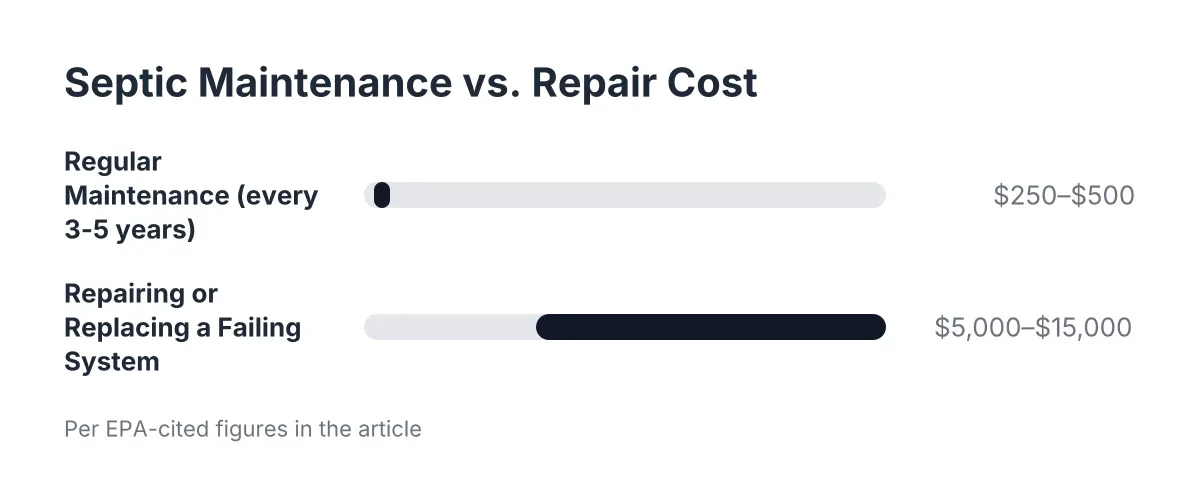
The U.S. Environmental Protection Agency puts regular septic system maintenance at $250 to $500 every three to five years. Spread over that interval, routine care often averages out to less per year than a single dinner service brings in. Compare that to what EPA cites for repairing or replacing a failed system: $5,000 to $15,000. That gap, not any single quote, is the number that should drive your decisions.
Prices in the Miami area vary with tank size, access, how full the tank is, and how many pump trucks compete for the work locally. Instead of chasing the cheapest septic tank pumping ad you can find, compare quotes on the same terms. Ask each company:
- Does the price include pumping both liquid and solids, or just the liquid layer?
- Is locating and uncovering the tank lid included, or billed separately?
- Is filter cleaning included in the visit?
- Is a basic inspection included, and will you get notes on what the crew saw?
- Are disposal fees included, or added after?
If two quotes differ by a wide margin, one of these five questions almost always explains why. A low headline price that excludes lid access, sludge removal, and disposal is not a low price. It is a partial price.
One honest caveat: no article can price your specific system. Tank size, condition, and access vary too much. Use these ranges to sanity-check quotes, and rely on a professional who has actually opened your tank for the real number. And if you suspect structural damage, a failing pump, or drain field trouble, get a professional inspection before spending anything on routine service.
Grease Traps: The Cost Schedule Restaurant Operators Actually Live On
Suppose you run a small restaurant in Little Havana with two fryers and a flat-top. Your grease trap fills on its own schedule, set by your menu and your volume, not by any brochure. Say the health inspector flagged the trap at your last visit, and now dinner-rush drains are slow and starting to smell. In that scenario, the cost question is no longer "how much is a grease trap clean out." It is "what does half a day of closed doors cost me." For most operators, one missed lunch service costs more than a year of scheduled trap cleanings.
That is why grease trap cleaning belongs in your annual budget as a recurring line, not an emergency one. A trap on a regular clean out schedule stays ahead of the inspector, keeps kitchen drains moving during service, and never surprises you with a backup on a Friday night. Depending on your grease output, that might mean monthly or quarterly service; a good local provider will look at how full your trap is at each visit and adjust the interval with you.
A few practical points for comparing commercial grease trap service quotes:
- One-off versus scheduled. One-off cleanings look cheaper per visit but leave you to remember the next one. Scheduled service costs about the same per visit and removes the compliance risk of forgetting. There is no rule that says you must sign a long contract; ask for scheduled visits without one if that fits you better.
- Full pump out versus skimming. A real grease trap clean out removes the grease cap, the food solids at the bottom, and the water in between, then scrapes the walls. Skimming just the top layer is faster and cheaper for the vendor, and your trap fills again in weeks. Ask which service the quote covers.
- Timing around service hours. A reliable local company will schedule around your prep and service windows. If a vendor cannot commit to a time that works for your kitchen, the quote does not matter.
- Documentation. Get a service record after every visit. When the inspector asks, paper answers faster than memory.
If your restaurant also sits on a septic system, coordinate the two. The same visit logic applies: a company that handles both grease trap cleaning and septic pump outs for businesses can often cover both needs with less scheduling friction than juggling two vendors.
Where People Overspend on Annual Septic Maintenance Costs
Most overspending on septic care comes from three habits, and all three are fixable.
First, buying additives instead of pumping. Products that promise to break down solids so you can skip service are the most common upsell in this trade. If you are wondering what to put in septic tank to break down solids, the honest answer is that a healthy tank already contains the bacteria it needs. No additive removes the sludge layer; only a pump out does. Regular pumping and periodic inspection prevent problems. Additives mostly prevent money from staying in your pocket.
Second, skipping intervals to save cash. Deferred pumping does not cancel the cost; it multiplies it. A neglected system needs pump outs more often once it falls behind, burns through filters faster, and wears out its pump sooner. Septic pump replacement cost alone can exceed several years of routine service, and a ruined leach field costs far more than that. The EPA's numbers make the case plainly: hundreds for maintenance, thousands for failure.
Third, paying twice for one truck roll. Separate visits for inspection and pumping, or for pumping and filter cleaning, mean paying travel and setup costs twice. Bundle everything the crew can do while the lid is open into one visit.
There is one place where spending more is the right call. If your property has an aerobic system, expect higher upkeep than a conventional tank. Aerobic systems have mechanical parts, pumps that fail, lines that need replacing, and filters that need cleaning, so their annual septic maintenance costs run higher by design. Budget for that reality instead of being surprised by it.
A Simple Yearly Budget Framework You Can Actually Use
Pull it together and the yearly picture for 2026 looks like this. For a home on a conventional system, plan for one combined pump out, filter cleaning, and inspection every two to three years, then divide that cost across the interval to get your true annual figure. For a business on septic, shorten every interval and add a standing grease trap clean out schedule if you run a kitchen.
When you compare septic service costs across local providers, judge quotes on what they include, not on the headline number. The five questions earlier in this guide will surface the difference in two minutes on the phone. A Miami-area company that answers them plainly, shows up when scheduled, and hands you a record of what was done is worth more than the cheapest line item you can find.
The underground part of your property does not have to be the unpredictable part of your budget. Put pumping, filter cleaning, inspection, and grease trap service on a calendar, price the whole visit instead of the pieces, and the hidden costs stop hiding.
If you need septic tank pumping, Miami Septic Tanks can help.
Prefer to talk it through? Call (786) 756-8032 — a quick call is usually the fastest way to get a straight answer for your situation.