How to Verify a Septic Company’s Licensing and Insurance in Miami
You have already picked a septic service, or you are about to sign off on one. Before the truck shows up, take twenty minutes to verify septic company insurance and licensing. That short check protects your restaurant from a health code mess, protects your properties from liability, and separates real local operators from the aggregator sites and out-of-state call centers that just resell your phone call. This guide walks through exactly what to verify, how to verify it, and what to do if something does not check out.
The stakes in Miami are higher than most people think. There are approximately 120,000 septic systems in Miami-Dade County across residential and commercial areas, according to Miami Waterkeeper. On top of that, Miami-Dade County's sanitary sewer system is under a Federal Court Order to correct existing problems and reduce the release of untreated sewage into the environment, according to Miami-Dade County. Regulators here take wastewater seriously. So should the company pumping your tank or cleaning your grease trap.
Why Septic Company Licensing and Insurance Matter More Than Price
Licensing and insurance matter because septic work is treated as a public health matter, not a handyman task. A pumping crew hauls raw sewage on public roads. A grease trap crew works inside your kitchen during or around service hours. If something goes wrong and the company is not properly credentialed and insured, the cost lands on you, not them.
Think about what can actually go wrong. A truck backs into your parking lot bollard. A hose fails and spills waste across your drive-thru lane. Additionally, a tech cracks a tank lid on a rental property you manage. With a properly insured company, their coverage handles it. With an uninsured one, you are chasing a company that may not even answer the phone next week.
For a restaurant operator, there is a second layer. Health inspectors expect your grease trap clean out to be documented and done by a legitimate hauler. A cheap cash job with no paperwork does not help you when the inspector asks for service records. For a property manager, the same logic applies across the whole portfolio. Documented service from an insured vendor is what protects the association or the management firm if a tenant claim ever surfaces.
Price still matters, and it is fine to compare bids. But septic company licensing insurance verification comes first. A low bid from an unverifiable company is not a deal; it is a liability with a discount sticker on it.
What Licensing Looks Like for Septic Work in Florida
In Florida, septic work falls under state and county oversight because of its impact on groundwater. That connection is direct: proper design, construction, and maintenance of septic systems help protect Florida's groundwater, which provides 90% of the state's drinking water, according to the Florida Department of Environmental Protection. That is why the state does not let just anyone pump, haul, or repair these systems.
Different jobs require different credentials, and this trips people up. Broadly, the work splits into a few categories:
- Pumping and hauling. Companies that pump tanks and haul waste need registration to transport septage, and their drivers generally need appropriate commercial licenses to operate the trucks legally.
- Installation and repair. Installing or relocating a system, or repairing a leach field, generally requires a licensed contractor and permits, since counties treat this as a public health issue.
- Grease trap service. Commercial grease trap clean out involves hauling and disposing of grease waste at approved facilities, with records your health inspector may want to see.
The distinction between pumping and installing is worth understanding. Becoming a licensed septic installer requires certification and licensing beyond a pumping operation, including passing exams on soil types, percolation rates, system design, and local regulations, according to the New Hampshire Department of Environmental Services. So a company that is legitimate for a pump out may not be credentialed for leach field repair. Ask which license covers the specific work you are booking.
Disposal is part of the licensing picture too. Septic waste pumped from tanks is transported by truck to a sewage treatment plant for disposal rather than processed on site, according to the New Hampshire Department of Environmental Services. A legitimate Miami-area hauler can tell you where the waste goes. A company that dodges that question is a red flag, because illegal dumping is exactly the kind of problem that federal court order exists to stop.
How to Verify Septic Company Insurance and Licensing, Step by Step
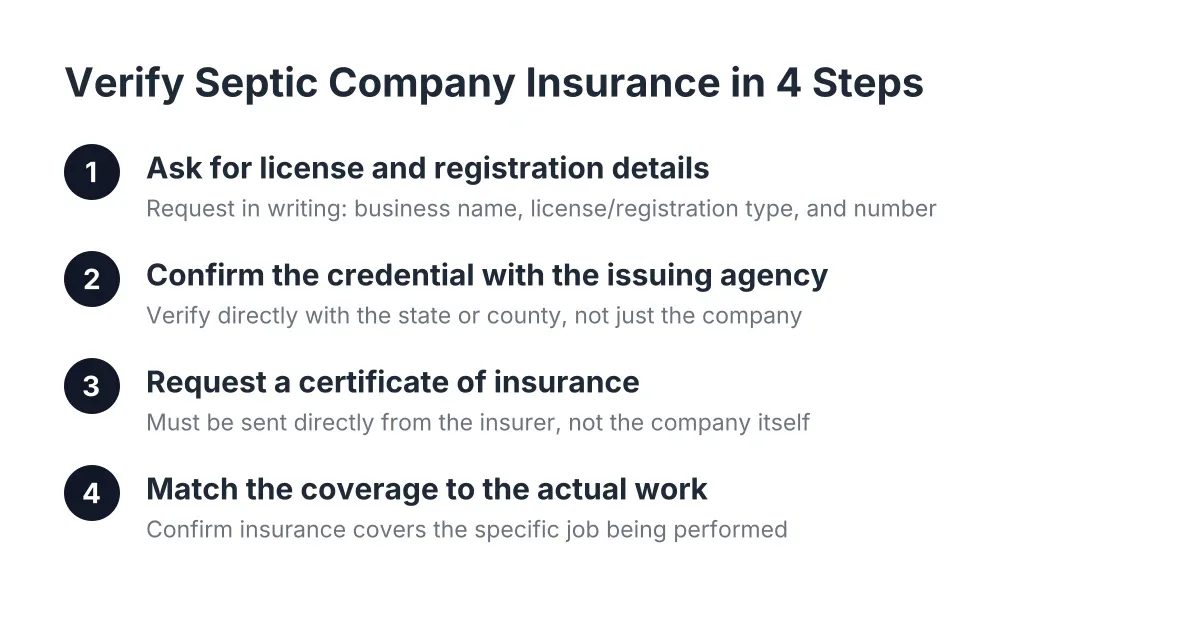
Verifying septic company insurance and licensing takes about twenty minutes: ask for the company's license or registration details, confirm them with the state or county, request a certificate of insurance sent directly from the insurer, and check that the coverage matches the work being done. Here is how to do each step without awkwardness.
Step 1: Ask for license and registration details in writing
Any legitimate septic pump out company expects this question. Ask for the business name as registered, the license or registration type, and the number. Get it by email or text so you have a record. If the person on the phone gets vague, defensive, or says "we've been doing this forever, don't worry," that is your answer. Real local operators answer this question every week without blinking.
Watch for a name mismatch. If the truck says one company, the invoice says another, and the license belongs to a third, slow down. Subcontracting happens, but you need to know whose credentials and whose insurance actually cover the job at your property.
Step 2: Confirm the credential with the issuing agency
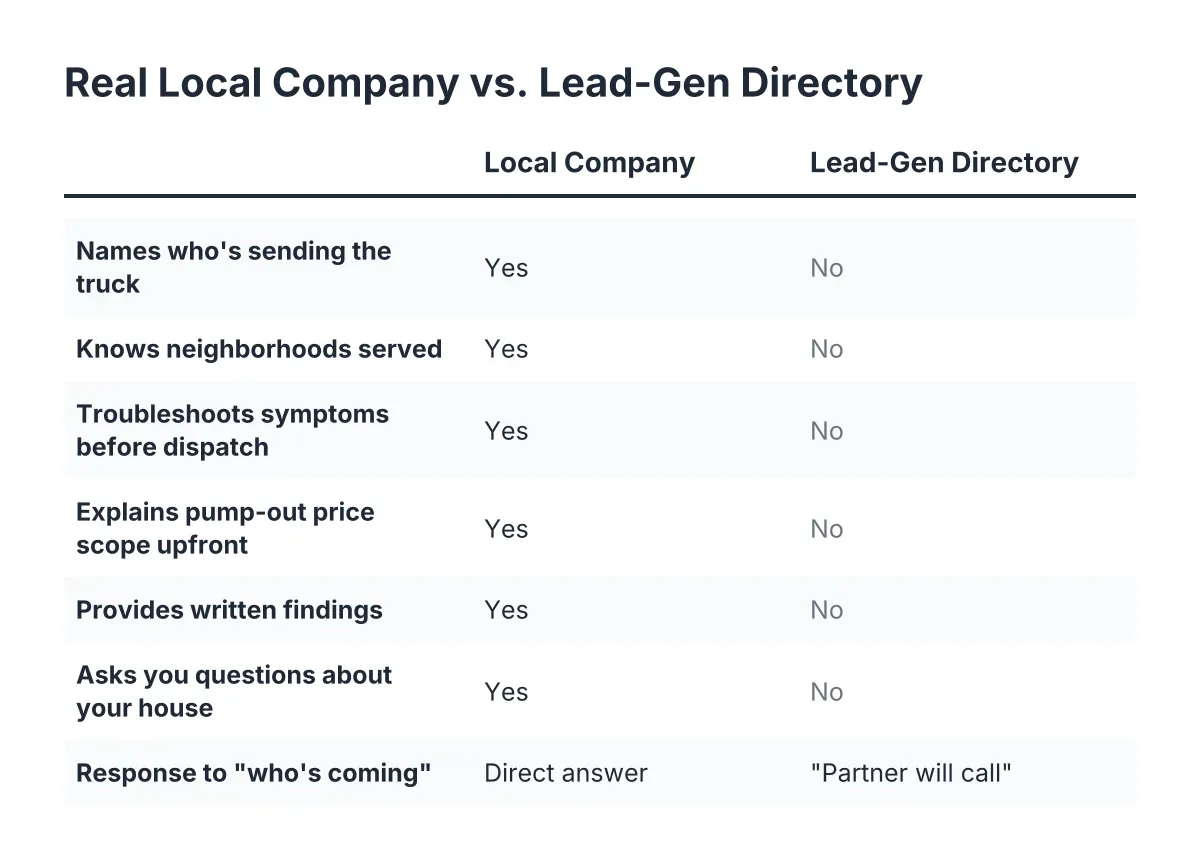
Do not stop at seeing a number; check it. Florida licenses and registrations can be looked up through state and county channels, and a quick search or phone call confirms the credential is current, matches the business name, and covers the type of work you booked. This is the step aggregator sites cannot do for you. When a national lead-gen site routes your call to whoever bought the lead this month, you have no idea whose license, if any, is behind the visit.
While you are at it, search the company name plus "complaints" and read recent septic company reviews with a skeptic's eye. One angry review means little. A pattern of no-shows, surprise charges, or mess left behind means a lot, especially if you are the restaurant operator who cannot afford a vendor who fails to show before an inspection.
Step 3: Request a certificate of insurance, sent from the insurer
A certificate of insurance, often called a COI, is a one-page summary of the company's coverage. Ask that it come directly from the insurance agent or carrier, not as a PDF the company emails you itself. Certificates are easy to fake or to keep circulating after a policy lapses. A carrier-issued COI closes that gap.
For property managers, make this standard practice. Many management firms and HOA boards already require vendors to list the property owner or association as a certificate holder. That way you get notified if the policy cancels mid-contract. If your portfolio has 5 to 50 septic-served properties, one lapsed vendor policy is a portfolio-wide exposure, not a single-site problem.
Step 4: Match the coverage to the actual work
Read the COI for three things. First, general liability coverage, which handles property damage and injuries at your site. Second, commercial auto coverage, since the pump truck itself is one of the biggest risks on the job. Third, workers' compensation, which matters because an injured worker without coverage can pursue the property owner. If the job involves leach field repair or anything beyond routine septic tank pumping, ask whether the coverage extends to that work.
Red Flags That Should Stop the Job Before It Starts
Most bad outcomes announce themselves early. If you see any of the following, pause before the truck arrives:
- No physical local presence. The number answers in another state, the "local" website has no address, and nobody can name the neighborhoods they serve. That is a lead reseller, not a Miami-area septic cleaner near me result you can trust.
- Cash-only pricing with no paperwork. No invoice means no service record, which hurts you at inspection time and at resale time.
- Refusal to name a disposal site. Legitimate haulers know exactly which treatment facility takes their loads and will say so.
- A quote wildly below everyone else. When you compare septic services near me prices, a bid at half the going rate usually means a partial pump, a bait-and-switch upcharge on site, or an uninsured operation.
- Pressure to skip the tank inspection or to sign a long contract on the spot. A real septic system professional explains what they found and lets the findings sell the work.
- Vague answers about who is actually coming. If they cannot tell you whether the crew is their own employees or a subcontractor, you cannot verify whose insurance applies.
One caution on the flip side: a company being small is not a red flag. Plenty of excellent Miami-area operators run lean. What matters is whether their credentials and coverage check out, not the size of their fleet.
How to Verify Septic Company Insurance Before a Grease Trap Inspection
Suppose you run a busy Cuban restaurant in Westchester and the health inspector flagged your grease trap at the last visit. You have a reinspection in three weeks, the kitchen drains slow down every dinner rush, and you cannot close, even for half a day. You call two companies for a grease trap clean out.
Company A quotes low over the phone, wants cash, and cannot say where the grease goes after pumping. Company B quotes a normal range, emails their registration details within the hour, has their agent send a COI the next morning, and offers a service window before your 11 a.m. open. Company B also provides a manifest showing the waste went to an approved facility, which is exactly the paper your inspector wants to see.
In that scenario, Company B costs more on the invoice and less in every way that matters. The manifest goes in your inspection folder. The COI goes in your vendor file. If a hose ever bursts across your patio, their insurance responds. That is the whole argument for verification in one job.
The same logic scales for a property manager. Say you oversee a 12-property portfolio in south Miami-Dade with a mix of septic-served duplexes. Verifying one vendor once, then putting them on a documented schedule across the portfolio, beats vetting a new stranger every time a tenant reports slow drains and you start wondering, is my septic tank full or clogged. A single verified vendor also gives you a consistent service history file, which matters for pre-sale inspections and insurance questions later.
What a Legitimate Local Provider Does Differently
The trust gap in this trade is real. National aggregator sites treat Miami like every other metro and route your call to whoever pays for leads. Thin local sites rank on decade-old content and offer no useful information. A legitimate local operator closes that gap through behavior you can observe before any work happens.
They answer the licensing insurance question directly, because a real septic company treats licensing and insurance as routine paperwork, not an interrogation. They ask smart questions before quoting, such as the tank's age, when it was last pumped, and whether the property sits low or near water; good companies gather that background before an inspection, because it changes what they look for. Furthermore, they put things in writing, including the scope, the price basis, and the service record afterward.
They also talk maintenance instead of fear. About 2 million Florida homes, about 30% of the state's residents, rely on septic systems, according to University of Florida IFAS, and flooded systems must be professionally cleaned. A trustworthy provider explains schedules calmly. For an active family of four, pumping the septic tank every two to three years is generally advisable, according to Penn State Extension. Compare that to the economics: regular maintenance of $250 to $500 every three to five years is a bargain next to a $5,000 to $15,000 repair or replacement, according to the U.S. Environmental Protection Agency. A vendor who leads with that math is planning a long relationship, not a one-time score.
Keep the Verification Working After You Hire
Verification is not a one-time gate. Once you have hired someone, a little structure keeps the relationship honest and keeps your records inspection-ready.
- File the paperwork. Keep the COI, license details, and every service invoice in one folder per property or per location. Digital is fine; findable is the point.
- Recheck the COI annually. Policies renew and lapse. If you are listed as a certificate holder, renewal notices come to you automatically.
- Put service on a calendar. Restaurants should schedule grease trap clean outs to match local code frequency and actual kitchen volume. Property managers should map pump out schedules across the portfolio so nothing slips between vendor visits.
- Ask for records every visit. A manifest or service ticket after each septic tank pumping or grease trap cleaning is your proof for inspectors, buyers, boards, and insurers.
- Reverify if anything changes. New owner, new company name, or new trucks with a different logo means new questions.
One honest limitation: verifying credentials tells you a company is legitimate, not that it is good at diagnosis. If your leach field is failing or a system needs relocation, get a proper septic system inspection and, for complex repairs, a second opinion from another licensed professional before committing to major work. Permits and county inspection requirements apply to installation and repair work, and a good contractor will walk you through them rather than around them.
The Twenty-Minute Habit That Protects Everything Else
Whether you searched for residential septic tank pumping near me for a duplex you manage or you need a grease trap crew before inspection week, the verification steps are the same. Get the license details in writing, confirm them with the issuing agency, get a carrier-issued COI, and match the coverage to the job. Hiring a septic company gets a lot less risky when you treat those four steps as non-negotiable, and any legitimate Miami-area operator will pass them without friction.
As of 2026, with Miami-Dade's wastewater infrastructure under active federal scrutiny and roughly 120,000 septic systems in the county, the pressure on this trade is only increasing. That is good news for you. It means the companies still operating clean, documented, insured service are easy to spot, if you take the twenty minutes to look.
If you need septic tank pumping, Miami Septic Tanks can help.
Prefer to talk it through? Call (786) 756-8032 — a quick call is usually the fastest way to get a straight answer for your situation.