Questions to Ask a Septic Company Before Hiring: A Miami Checklist
When sewage is backing up through your drains, the last thing you want is a phone maze that routes you to a call center three states away. Knowing what to ask a septic company before you hire them is how you avoid that runaround. Understanding the right septic company hiring questions separates a real local Miami-area operator from an aggregator site or a placeholder page that ranks on old content but can't actually help you. This FAQ walks through the questions that separate quality service from shortcuts.
Each answer below is short on purpose. Read the ones that match your situation, ask the questions on the phone, and you'll know within five minutes whether you're talking to someone who can solve your problem.
Why Do the Questions You Ask a Septic Company Before Hiring Matter So Much?
The questions you ask a septic company before hiring matter because the septic industry has a trust gap. National lead-gen sites collect your call and sell it to whoever pays, while some thin local sites rank on Google but haven't been updated in years. A few direct questions expose who actually does the work in Miami and who just brokers your phone number.
That gap hits hardest when you're panicked. If your toilet is backing up right now, you're likely to hire the first person who answers. Slowing down for two or three questions costs you a minute and can save you from a bad crew or an inflated invoice.
Am I Talking to a Local Company or a Lead-Gen Directory?
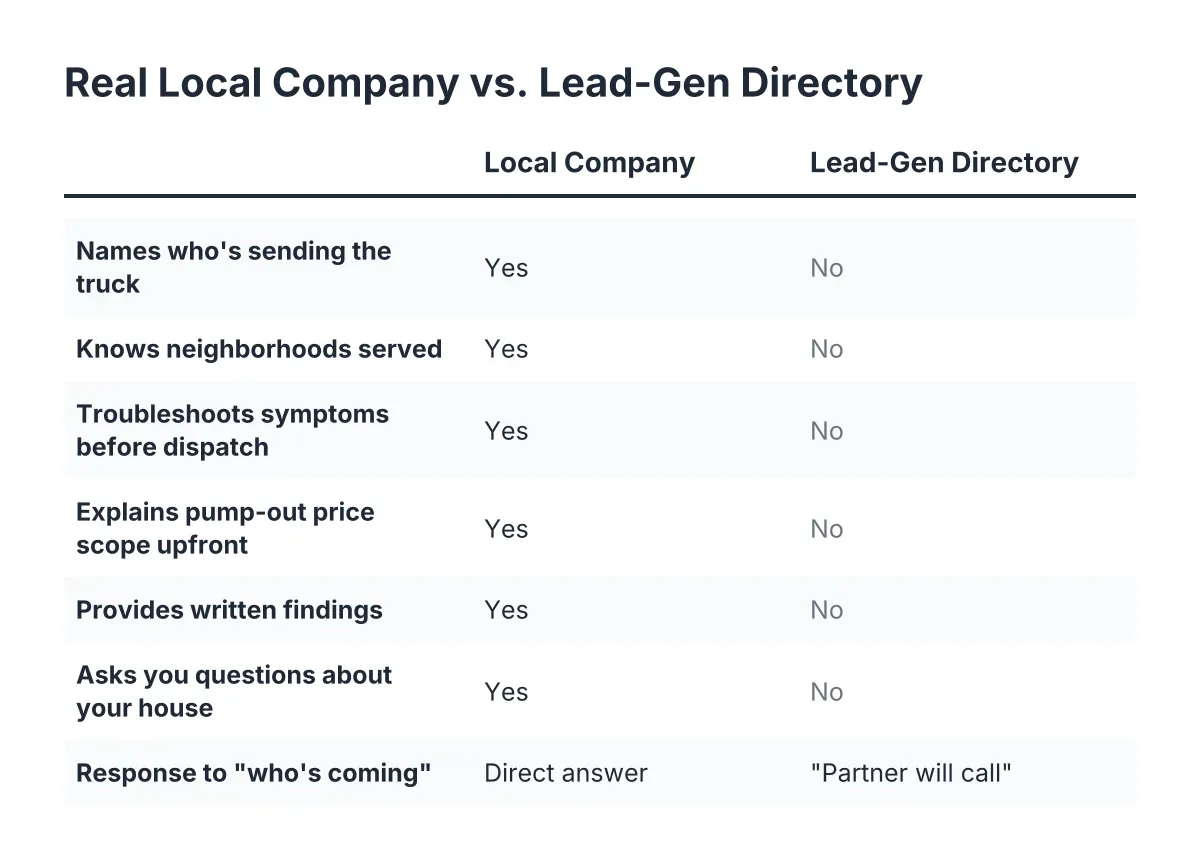
Ask directly: "Are you the company sending the truck, or do you pass my info to someone else?" A real local operator can tell you who is coming and roughly where they're based. A directory or out-of-state call center dodges the question or says "one of our partners will contact you."
This is the single fastest filter when you search for septic services near me. If the person on the phone can't name the neighborhoods they serve, such as Miami, FL and surrounding areas, keep dialing.
Is My Problem a Septic Issue or a Plumbing Issue?
A backup can come from either the septic system or the plumbing, and a good company will help you sort that out on the phone. If every drain in the house is slow, sewage is coming up at the lowest fixture, or there's standing water over the tank or leach field, the septic system is the likely cause. If only one fixture is clogged, it's probably a plumbing problem.
Ask the company how they'd tell the difference before they dispatch anyone. A trustworthy answer sounds like troubleshooting. A red-flag answer is "we'll figure it out when we get there," with no questions about your symptoms. In addition, if you do end up calling a plumber, tell them upfront that your home is on a septic system; it changes how they diagnose the problem.
What Should I Ask a Septic Company Before They Pump My Tank?
Before any pump out, ask a septic company these questions: What does the price include? Will you pump the whole tank or just the liquid layer? Do you check the baffles, the filter, and the tank condition while it's open? Will you tell me what you find before doing any extra work?
A full pump out removes both liquid and solids. Some low-price operators pump only the liquid, which leaves the sludge behind and puts you right back where you started in a few months. A thorough visit also includes a look at the tank for cracks, a check that the baffles are working, and confirmation that flow to the leach field looks normal.
Here is a quick checklist you can read off the phone:
- Are you a local operator, or do you route calls elsewhere?
- Is the quote for a full pump out, solids included, or liquid only?
- What could add to the price once you're on site, like locating or digging to the lid?
- Do you inspect the tank, baffles, and septic tank filter while it's open?
- Will you walk me through what you found before you leave?
- Do you put the findings and any recommendations in writing?
How Do I Avoid Being Price-Gouged in a Backup Emergency?
To avoid gouging during a septic backup, get the scope in writing before the truck arrives, even if it's just a text. Ask what the base pump out covers, what triggers extra charges, and whether they charge more for after-hours calls. Vague answers before the visit become expensive surprises after it.
For context, the U.S. Environmental Protection Agency notes that regular septic maintenance runs about $250 to $500 every three to five years, while repairing or replacing a failed system can cost between $5,000 and $15,000. So a pump out quote should sit in the maintenance range, not the repair range. If someone quotes repair-level money for an emptying job, ask them to explain exactly why. When comparing septic tank pumping near me prices online, remember the honest number is the one tied to a written scope, not the lowest teaser figure.
Key Septic Company Hiring Questions for Grease Trap Contracts
Restaurant and food service operators should ask a septic company before signing whether they handle grease trap clean out as a scheduled service, how they document each cleaning, and whether they understand Miami-Dade compliance requirements. You also want to know if they clean the trap fully or just skim the surface grease.
Documentation is the part that protects you. Suppose a cafe owner in Little Havana gets an odor complaint two weeks before a health inspection. If her grease trap cleaning company keeps dated service records, she can show the inspector a maintenance history on the spot. If the company can't produce paperwork, she's arguing from memory. Ask for sample service records before you commit to a monthly or quarterly schedule.
Should the Company Ask Me Questions Too?
Yes, and this is one of the strongest trust signals. A capable septic system professional asks about your house before quoting: how old is the home, when was the tank last pumped, has the system been repaired before, and does the property sit low or near water. Those answers change how they approach the job.
Therefore, treat silence as a warning. If a company quotes a flat number without asking a single question about your system, they're pricing a lead, not a job. The best septic company near me is usually the one that interviews you back.
How Often Should the Tank Be Pumped, and Will They Tell Me Honestly?
Most tanks need pumping every three to five years, according to University of Florida IFAS, and the EPA recommends inspecting the whole system every 1 to 3 years. For an active family of four, Penn State Extension advises pumping every two to three years because a busier household produces more solids.
Ask the company what schedule they'd recommend for your household size and why. An honest operator ties the answer to your usage. A dishonest one pushes a yearly pump out on a two-person household with no explanation. In 2026, with more than 26 million U.S. homes on septic systems according to Census Bureau data cited by EPA, routine maintenance is a well-understood job; there's no mystery that justifies over-servicing.
What Red Flags Mean I Should Hang Up?
Hang up on any septic company that won't say where they're located, refuses to explain what the quoted price covers, or pressures you to approve major repairs sight unseen. Scare tactics are the classic septic scam: a routine pump out visit that suddenly becomes "your whole leach field is failing" with no evidence shown.
For example, a legitimate crew that suspects leach field trouble will show you the signs, like standing water, sewage odor over the field, or a tank that won't drain down, and explain the next diagnostic step. They won't demand a five-figure decision on the spot. When you're hiring a septic company, the willingness to show their work is worth more than any promise they make on the phone.
When Do I Need a Full Inspection Instead of Just a Pump Out?
A full septic system inspection makes sense when you're buying or selling a home, when backups keep recurring after pumping, or when you see wet spots over the leach field. A pump out empties the tank; an inspection checks the tank for cracks, verifies the baffles, tests the filter, and confirms drainage is flowing as it should.
This matters in South Florida for more than your own yard. Proper septic maintenance helps protect Florida's groundwater, which supplies 90% of the state's drinking water, according to the Florida Department of Environmental Protection. That said, no article can diagnose your specific system. If sewage is actively backing into your home, or you suspect leach field failure, get a professional on site rather than troubleshooting from a checklist alone.
The Bottom Line
Five minutes of questions beats five years of regret with the wrong company. Confirm they're local, confirm what the price includes, confirm they inspect while they pump, and expect them to ask about your system in return. Any Miami-area operator worth hiring will welcome every question on this list.
If you need septic tank pumping, Miami Septic Tanks can help.
Prefer to talk it through? Call (786) 756-8032 — a quick call is usually the fastest way to get a straight answer for your situation.