How Long Does Leach Field Repair Take? A Realistic Timeline for Miami Homes
If you are staring at a soggy patch of yard and wondering how long a leach field repair timeline takes, the honest answer is anywhere from one day to several weeks. That range sounds unhelpful until you break it down. The timeline depends on what failed, how bad it is, whether permits are needed, and how fast the soil under your yard can recover. This guide walks through each scenario so you know what to expect before a crew ever shows up, and so nobody can scare you into rushing a decision.
Most articles on this topic either dodge the question or push you toward a "call for quote" form. We will do the opposite. Below you will find realistic timelines for minor fixes, partial repairs, and full replacements, plus the steps that eat up the calendar, like permits and perc tests. By the end, you should be able to look at your own situation and estimate how long your yard will be torn up.
First, What a Leach Field Actually Does
A quick refresher helps the timelines make sense. A typical residential septic system has two main parts: a tank that separates and clarifies wastewater, and a drain field that disperses the clarified liquid into the ground, according to the US EPA. The leach field, also called a drain field, is the second half of that system.
After the tank does its job, wastewater flows out through perforated lateral pipes into the absorption field. There, it filters through gravel or stone and then through sand and soil layers, according to the U.S. Environmental Protection Agency. The field itself is built by laying a thick layer of gravel, placing perforated septic drain field pipe on top, adding more gravel over the pipes, and burying the whole assembly with soil. Some newer systems skip the gravel and use plastic septic drain field chambers instead, which distribute effluent across a bed of sand.
Why does this matter for your timeline? Because the repair clock depends on which layer failed. A clogged pipe near the tank is a fast fix. Saturated soil deep in the field is a slow one. Knowing the anatomy helps you understand why one neighbor's repair took an afternoon and another's took a month.
How Long Does a Leach Field Repair Take, Step by Step?
A straightforward leach field repair usually takes one to three days of actual work. A full replacement usually takes one to two weeks of digging and installation, plus permit and inspection time before the crew ever breaks ground. The total calendar time, from first phone call to finished yard, commonly runs two to eight weeks for bigger jobs.
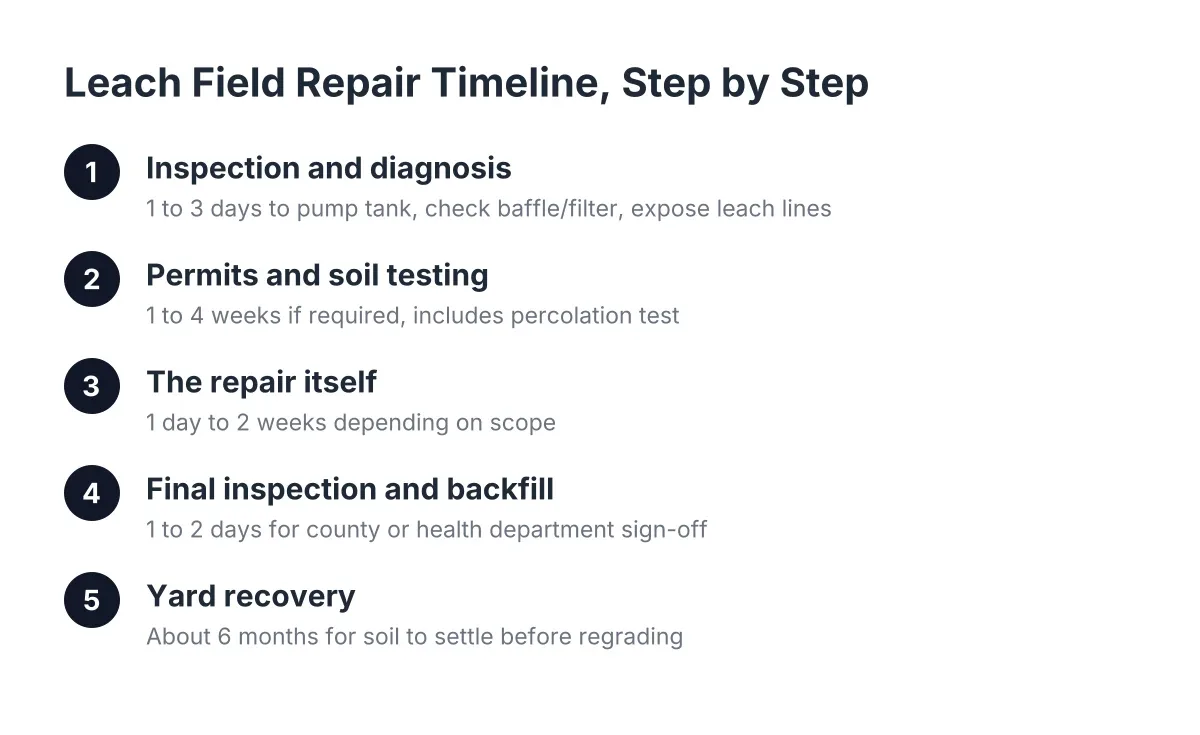
Here is how that time typically breaks down:
- Inspection and diagnosis: one to three days. A technician pumps the tank, checks the outlet baffle and filter, and exposes the leach lines away from the tank. If the lines hold standing water, the field is saturated. If they are dry or full of root debris, the problem is a blockage. This single check often determines the whole repair path.
- Permits and soil testing: one to four weeks, if required. Repairs that involve new field area usually need county sign-off. A percolation test must be dug and performed before installing a new system to confirm the soil drains properly, according to University of Nebraska-Lincoln Extension. Local health department inspection is typically part of the process too.
- The repair itself: one day to two weeks. Clearing a clogged pipe or replacing a crushed section can wrap up in a day. Excavating and replacing full leach lines, or installing new chambers, takes longer.
- Final inspection and backfill: one to two days. The county or health department may need to see the work before it gets buried.
- Yard recovery: months. After backfilling a full system, standard practice is to let the soil over the chambers settle for about six months before regrading and finishing the surface. Plan your landscaping accordingly.
The lesson here is that the digging is rarely the slow part. Paperwork and soil are. In Miami-Dade, permit timelines vary by workload and season, so build slack into your plan rather than counting on a specific week.
Timelines by Repair Type: From an Afternoon to a Month
Not every failing field needs the full treatment. Match your symptoms to the likely repair, and you can predict the timeline within a reasonable range.
Minor fixes: same day to two days
Some problems that look like field failure are actually upstream. A clogged septic tank filter, a full tank, or a blocked outlet pipe can all cause slow drains and backups that mimic a dying field. Septic tank pumping and septic tank filter cleaning take a few hours. Clearing or replacing a short run of damaged pipe between the tank and the field usually takes a day.
Therefore, always start with the cheap, fast checks. A pump out and inspection is the quickest way to rule out the simple stuff before anyone talks about excavation.
Partial leach field repair: two days to a week
If only a section of the field failed, say one crushed line under a driveway or one root-invaded lateral, a crew can often replace just that section. Expect two to five working days once permits are handled. The leach field repair timeline for partial fixes involving root removal, pipe replacement, and jetting the remaining lines all fit inside this window.
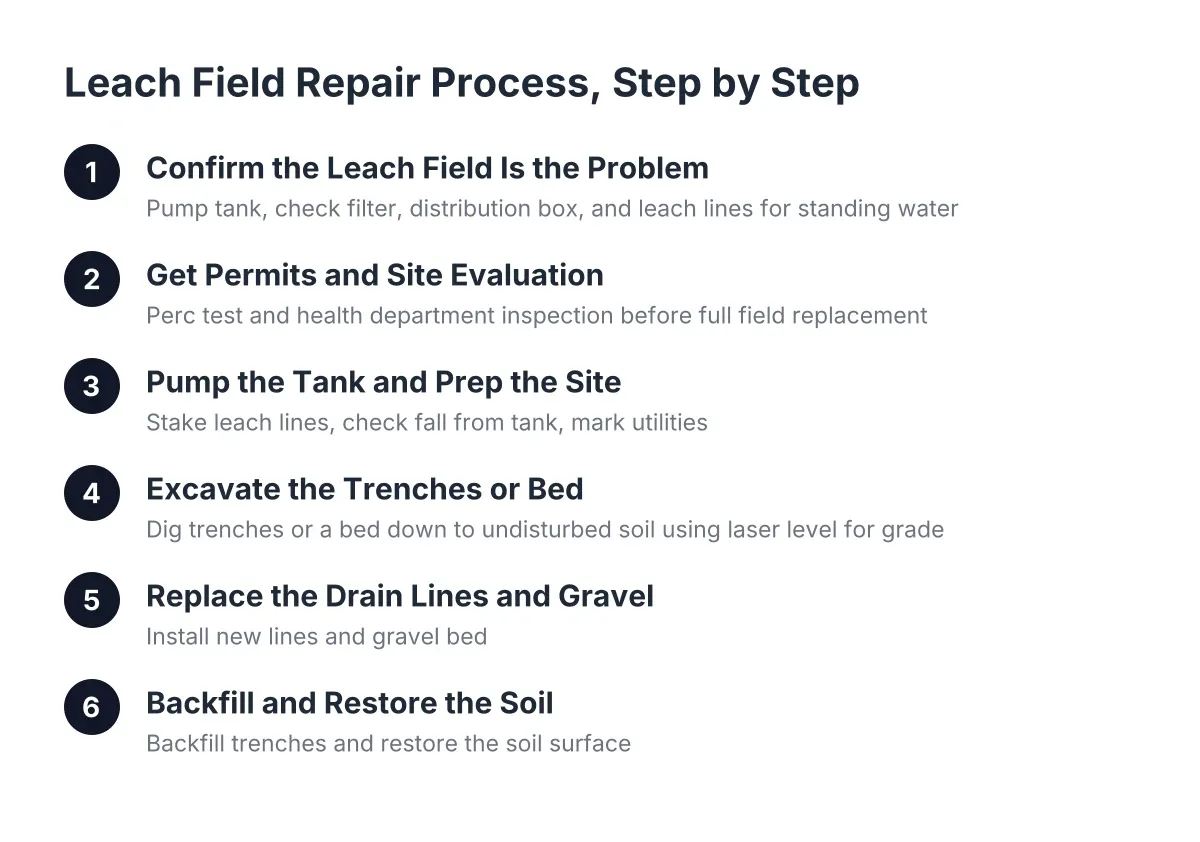
However, once a field is clogged by grease, solids, or other non-degradable waste, spot fixes rarely hold. The typical remedy at that point is excavating and replacing the leach lines, not just pumping the tank. A good contractor will tell you honestly which situation you are in, and the standing-water check on the exposed lines is how they know.
Full replacement: two to eight weeks, start to finish
Replacing a leach field usually means replacing the whole system, with a new percolation test and evaluation before design and installation. The physical work often takes one to two weeks. The permit and testing phase in front of it can take just as long or longer. Understanding the leach field repair timeline for a full replacement means planning on two months of calendar time to be safe, even if the crew is only on site for ten days.
The required length of the new field depends on your soil's absorption rate and household size, not a fixed standard. That is why nobody can quote a firm timeline or footprint before the perc test comes back. Anyone who does is guessing.
Can a Saturated Field Dry Out on Its Own, and How Long Does That Take?
A saturated leach field can sometimes recover if the overload was temporary, and drying out typically takes several weeks to a few months of sharply reduced water use. This approach, often called field resting, only works when the soil is waterlogged but the pipes and gravel bed are still intact. If the field is clogged with solids or biomat, resting alone will not fix it.
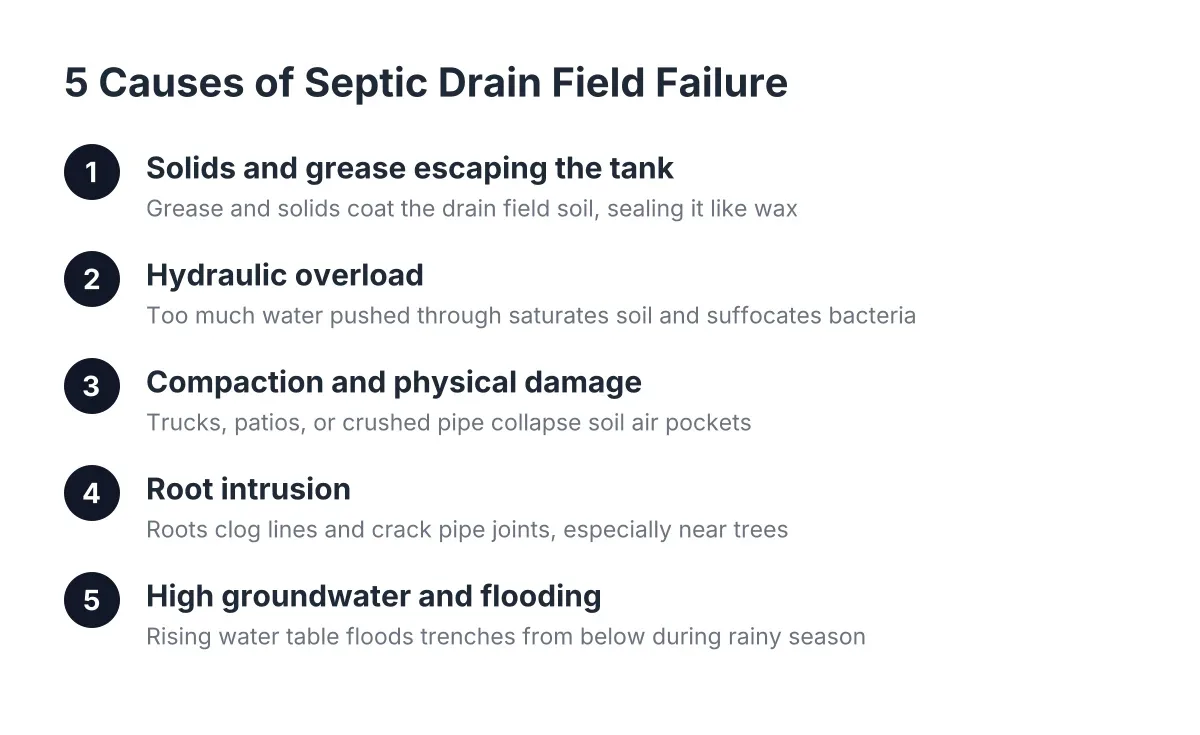
Most leach field failures come down to one of two causes: hydraulic overload, which is too much water, or biological overload, which is too much organic material reaching the field. If yours is a water problem, say from a leaking toilet, a big houseguest month, or heavy rains sitting on already-stressed soil, cutting water use hard for four to eight weeks can let the soil breathe again. Pumping the tank during this period keeps effluent out of the field while it rests.
For example, suppose a Miami homeowner notices standing water over the field after two weeks of summer storms plus a running toilet nobody caught. In that scenario, fixing the toilet, getting a pump out, and spreading out laundry loads might bring the field back within a month or two, with no digging at all. That is the best-case timeline, and it costs a service call instead of an excavation.
The catch is that Miami's high water table and rainy season work against you. A field that barely recovers each summer is telling you something. If saturation returns every wet season, resting is a delay, not a fix, and it is time to price actual leach field repair before the problem becomes sewage in the yard. Delay lets a wet spot turn into an overflow, which is a health risk, not just a landscaping issue.
What Slows a Repair Down in Miami
Every region has its friction points. In Miami-Dade and the surrounding areas, a few local factors regularly stretch timelines, and knowing them ahead of time keeps you from blaming the contractor for the calendar.
- High groundwater. South Florida's water table sits close to the surface. Wet-season groundwater can delay excavation or force design changes, like a mounded field. Proper system design matters here for more than convenience; well-built septic systems help protect Florida's groundwater, which supplies 90% of the state's drinking water, according to the Florida Department of Environmental Protection.
- Permit and inspection queues. Repairs that add or replace field area typically need health department review. As of 2026, expect this to be measured in weeks, not days, and to vary with the season.
- Rain delays. You cannot install a drain field in a flooded trench. A week of afternoon storms can push a two-day job into a second week.
- Access. Fields under mature landscaping, pavers, or tight side yards take longer to reach and longer to restore.
- Engineering requirements. Full replacements often need an evaluation by a qualified engineer plus a fresh perc test before design approval.
None of these are reasons to panic. They are reasons to start the process at the first symptom instead of waiting for a backup. A homeowner who calls about a mild odor in March has options. One who calls about sewage in the hallway in September, mid rainy season, has fewer.
How Long Do Leach Fields Last, and When Is Repair Worth It?
A well-built, well-maintained leach field commonly lasts 20 to 30 years, and the septic tank itself can last up to 30 years with proper maintenance, according to University of Florida IFAS. Age matters when you are weighing a repair timeline against a replacement timeline. Spending a week fixing a 28-year-old field may buy you two years. Spending six weeks replacing it buys you decades.
Here is the trade-off in plain terms. A partial repair is faster and cheaper up front, but on an old field it can become the first payment in a series. A replacement is slower and more disruptive, but it resets the clock. If your field is under 15 years old and failed from a specific, fixable cause, like roots or a crushed line, repair usually makes sense. If it is past 20 and failing broadly, the longer replacement timeline is often the shorter path over a five-year horizon.
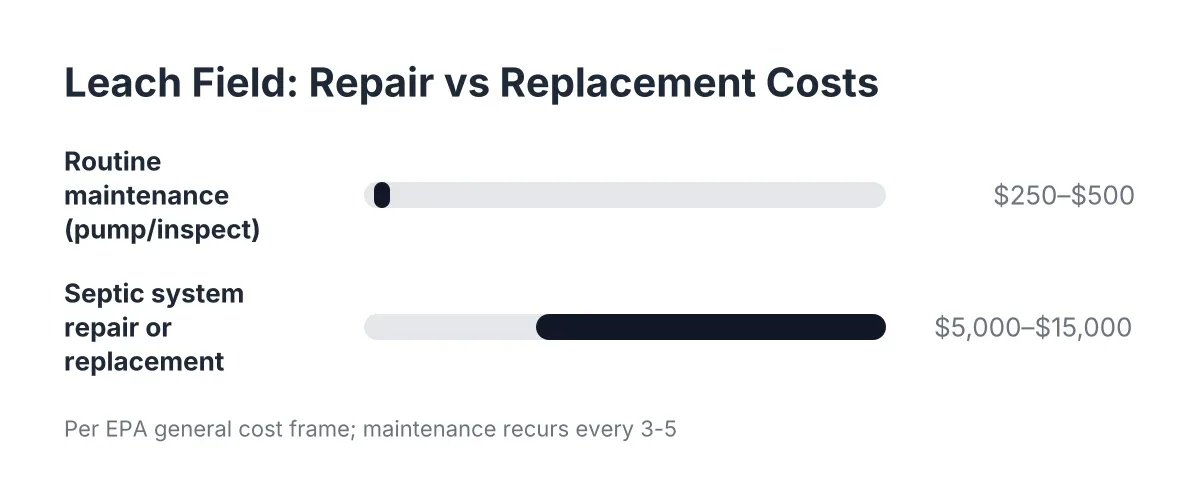
Maintenance is what stretches the lifespan and keeps you off the repair calendar entirely. The U.S. Environmental Protection Agency recommends inspecting the whole septic system every 1 to 3 years and pumping the tank every 3 to 5 years. The same source notes that routine maintenance running $250 to $500 every three to five years is a bargain next to repairing or replacing a failed system, which can cost between $5,000 and $15,000. For a Routine Maintenance Planner, that is the whole argument in two numbers: a scheduled pump out every few years versus a five-figure excavation and a torn-up yard.
One more reason maintenance is not optional: even a healthy system loads the soil around it. A conventional septic tank removes only about 30 percent of the nitrogen that flows into it, according to University of Florida IFAS, so the field does real work every single day. Give it less to handle and it lasts longer.
Restaurants and Commercial Kitchens: Add Grease to the Timeline Math
Commercial properties on septic face a faster failure clock. Grease is the single most effective leach field killer, because it coats soil and builds biomat far quicker than household waste. A restaurant, cafe, or hotel kitchen sending grease past a neglected trap can take a field from healthy to clogged in a fraction of a home's timeline.
For food service operators, the repair timeline also carries a second cost: downtime. Say a small Little Havana restaurant discovers its field is saturated during the run-up to a health inspection. In that hypothetical, a two-week excavation is not just a repair bill; it is two weeks of managing pump outs, odors, and possibly restricted water use during service. That is why regular grease trap clean out and grease trap cleaning on a set schedule is the cheapest line item in the whole equation. It keeps grease out of the tank and the field, and it keeps the compliance file clean when the county comes calling.
The planning takeaway is the same for a business as for a home, just compressed. Pump on schedule, clean the trap on schedule, and treat the first slow drain as a diagnostic trigger, not an annoyance.
What You Can Do Today to Shorten Any Future Repair
The fastest leach field repair is the one you never need. The second fastest is the one you catch early, when the fix is still a section of pipe instead of a whole field. A few habits stack the odds in your favor.
First, get on a pumping schedule and stop tracking it in your head. University of Florida IFAS recommends pumping every three to five years, and a local company can put you on a recurring reminder so the interval never slips. If you just bought a home with a septic system and have no service records, book a septic system inspection now; it establishes a baseline and tells you how much life the field likely has left.
Next, watch water and watch what goes down the drain. Fix running toilets fast, spread laundry across the week, and keep grease, wipes, and food solids out of the system. Since most field failures trace back to too much water or too much organic load, these small habits directly extend how long the field lasts.
Finally, know your field's location and keep it clear. No parking, no pavers, no heavy planting over the lines. When a crew does need access, an open grass field cuts a day or more off the job.
One honest caveat to close on: no article can diagnose your specific field. Symptoms overlap, and a wet spot can mean anything from a full tank to a collapsed line to a seasonal water table issue. Before committing to any repair, have a local pro pump the tank, check the filter, and expose the lines to see what is actually happening underground. If you are searching for septic tank repair near me in Miami, FL and surrounding areas, look for someone willing to do that diagnostic step and explain the findings in plain language. The right answer to how long your repair will take starts with knowing exactly what broke, and that costs a service call, not a leap of faith.
If you need septic tank pumping, Miami Septic Tanks can help.
Prefer to talk it through? Call (786) 756-8032 — a quick call is usually the fastest way to get a straight answer for your situation.