The Leach Field Repair Process Step by Step: Excavation to Soil Restoration in Miami, FL
A failing leach field is the repair most septic owners dread, mostly because nobody explains what actually happens once the crew shows up. This guide walks through the leach field repair process step by step: diagnosis, excavation, drain line work, and soil restoration. If you own a home on septic in Miami, FL, knowing these steps helps you judge a quote, ask better questions, and avoid paying for work you do not need.
One quick frame before the steps. A conventional septic system has two main parts: the tank, which clarifies wastewater, and the drain field, which disperses the clarified liquid into the ground, according to the U.S. Environmental Protection Agency. When the field fails, the liquid has nowhere to go. That is why you see soggy grass, slow drains, and backups. Repairing the field means restoring that path into the soil.
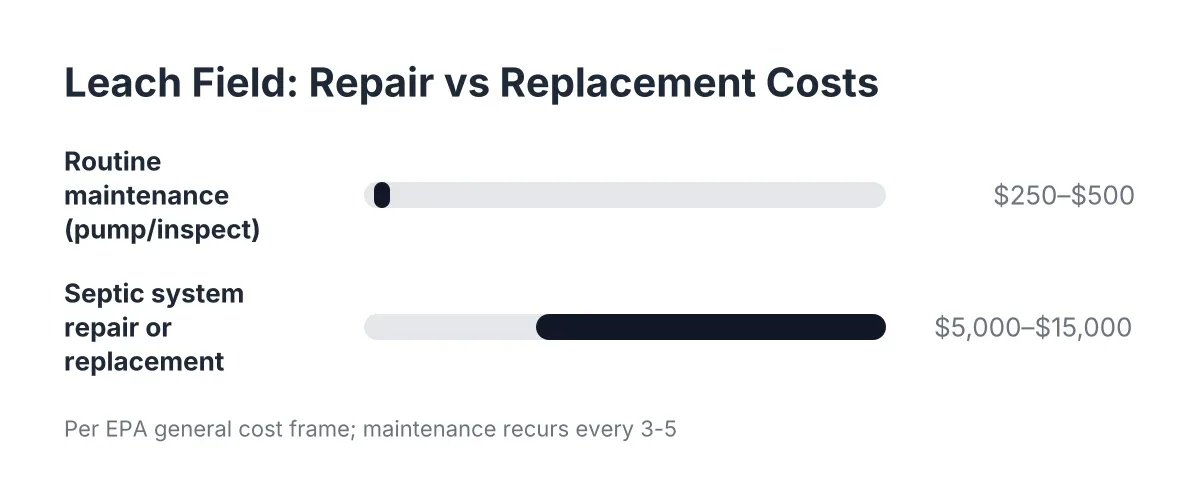
As for money, the U.S. Environmental Protection Agency notes that regular maintenance of about $250 to $500 every three to five years is a bargain next to repairing or replacing a failed system, which can run $5,000 to $15,000. Most Miami-area leach field repairs land somewhere inside that wide band, depending on how much of the field needs work. Keep that range in mind as you read; any quote far outside it deserves a second opinion.
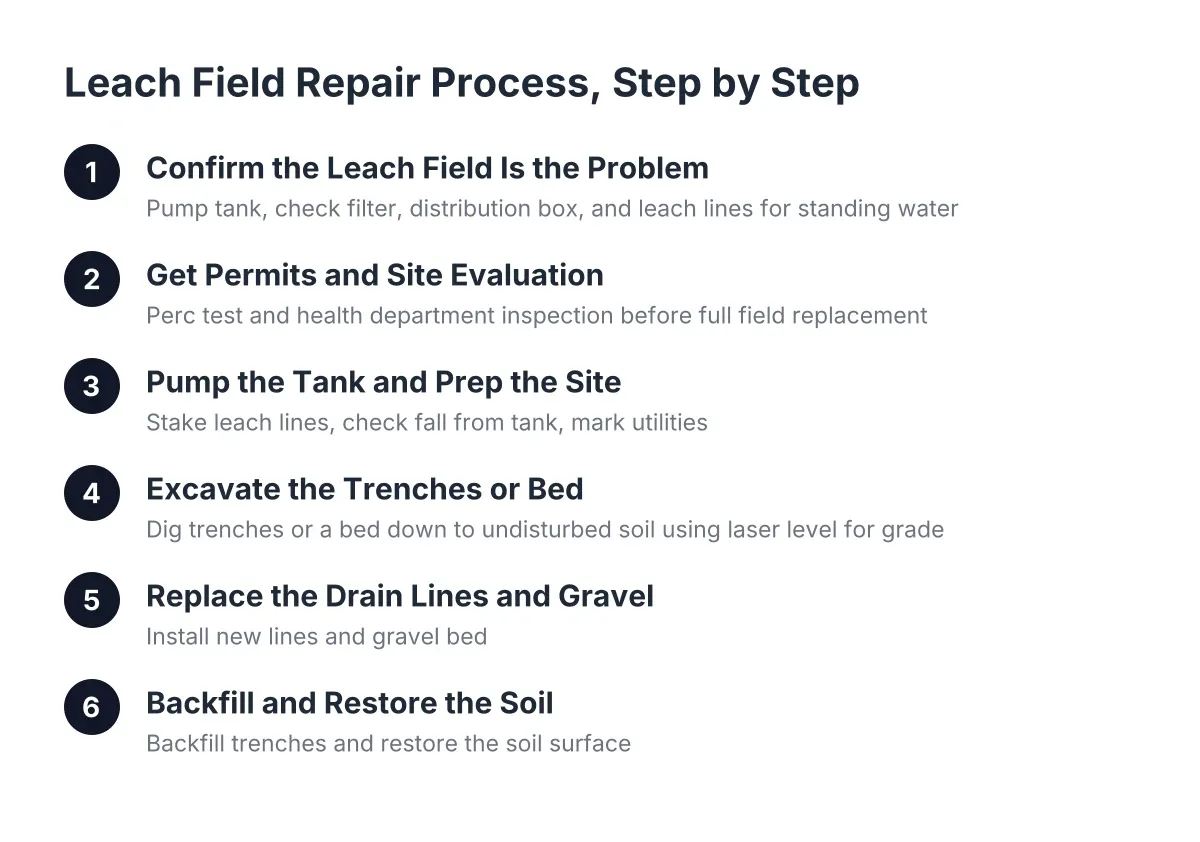
Step 1: Confirm the Leach Field Is Actually the Problem
Do not let anyone dig up your yard until the diagnosis is solid. Plenty of "failed field" symptoms come from cheaper problems: a tank that has not been pumped in years, a clogged outlet filter, or a blocked line between the house and the tank. A septic tank pumping and inspection visit rules those out first.
A thorough inspection in Miami, FL usually covers:
- Pumping the tank and checking sludge and scum levels
- Cleaning or replacing the septic tank filter at the outlet
- Checking the distribution box for tilting, clogs, or uneven flow
- Probing or exposing a section of the field to look for standing water
- Watching how fast water levels drop after a pump out
Here is the key diagnostic move. The crew exposes a leach line away from the tank and checks whether it holds standing water or sits dry, and whether roots have grown in. A saturated line points to clogged soil or a biomat problem. A dry line with a backed-up tank points upstream, often to the distribution box or the outlet pipe. Root debris changes the repair path again.
Suppose a homeowner in Coral Gables notices sewage odor near a wet patch of lawn. In that scenario, a pump out plus filter cleaning might cost a few hundred dollars and buy time, while confirming whether the field itself is saturated. That is a far better first move than approving excavation on day one.
Step 2: Get the Permits and Site Evaluation Sorted
Leach field work is regulated, and for good reason. Proper design, construction, and maintenance of septic systems help protect Florida's groundwater, which supplies 90% of the state's drinking water, according to the Florida Department of Environmental Protection. Miami-Dade takes wastewater seriously; the county's sanitary sewer system is even under a Federal Court Order to reduce releases of untreated sewage, per Miami-Dade County.
Therefore, expect paperwork before shovels. For a full field replacement, the site typically needs a new percolation test. A perc test measures how well the soil absorbs water, and it must be done before installing a septic system to confirm the ground can handle effluent, according to University of Nebraska-Lincoln Extension. Dense or waterlogged soil will not pass. A local health department inspection is also a normal part of the process, per Caroline County Health Department guidance on septic installs.
In addition, replacing a leach field often means the whole system gets re-evaluated, sometimes by an engineer, with the septic drain field design updated to current rules. High water tables in parts of Miami, FL can force a mounded or modified design. This is one place where DIY genuinely cannot help; installing or replacing a field requires licensing beyond what a pumping operation carries, as the New Hampshire Department of Environmental Services notes about installer requirements generally.
Step 3: Pump the Tank and Prep the Site
Before excavation, the crew pumps the tank completely. This stops wastewater from flowing into the work area and gives the field a rest. If your home stays occupied during the job, plan to cut water use hard for a day or two: short showers, no laundry marathons, no dishwasher cycles back to back.
Next comes layout. All leach lines get staked out and checked for adequate fall from the tank before anyone digs. Skipping this step is how jobs stall halfway through, when a crew discovers the grade does not allow gravity flow to the far trench. Lines are laid out on contour, following a level path across the grade rather than a straight sightline, because the ground's elevation shifts where a level line actually runs.
The crew also marks utilities, fences off the work zone, and plans where excavated soil will sit. On a tight Miami lot, that staging plan matters as much as the digging.
Step 4: Excavate the Trenches or Bed
Now the visible part starts. For a trench-style repair, an excavator opens trenches along the staked lines, typically a few feet wide and a few feet deep, down to undisturbed soil. For a bed-style system, the crew opens one larger area instead.
Two details separate a careful job from a sloppy one. First, leach lines must sit dead level, with no slope at all, unlike the pipe feeding the tank. Crews use a rotary laser level to hold that precision across every trench. A trench that tilts even slightly sends effluent to one end, overloads that soil, and shortens the field's life.
Second, the trench sidewalls get scarified, meaning roughened with a steel tine rake. Excavator buckets smear and compact soil as they dig, which seals the very surface the field depends on. Scarifying reopens the soil pores, and it works especially well in the sandy soils common across the Miami area.
Expect your yard to look rough during this phase. Trenches, soil piles, and machine tracks are normal. A typical residential job runs from a couple of days to about a week, weather permitting; South Florida rain can pause excavation because trenches must stay workable.
Step 5: Replace the Drain Lines and Gravel
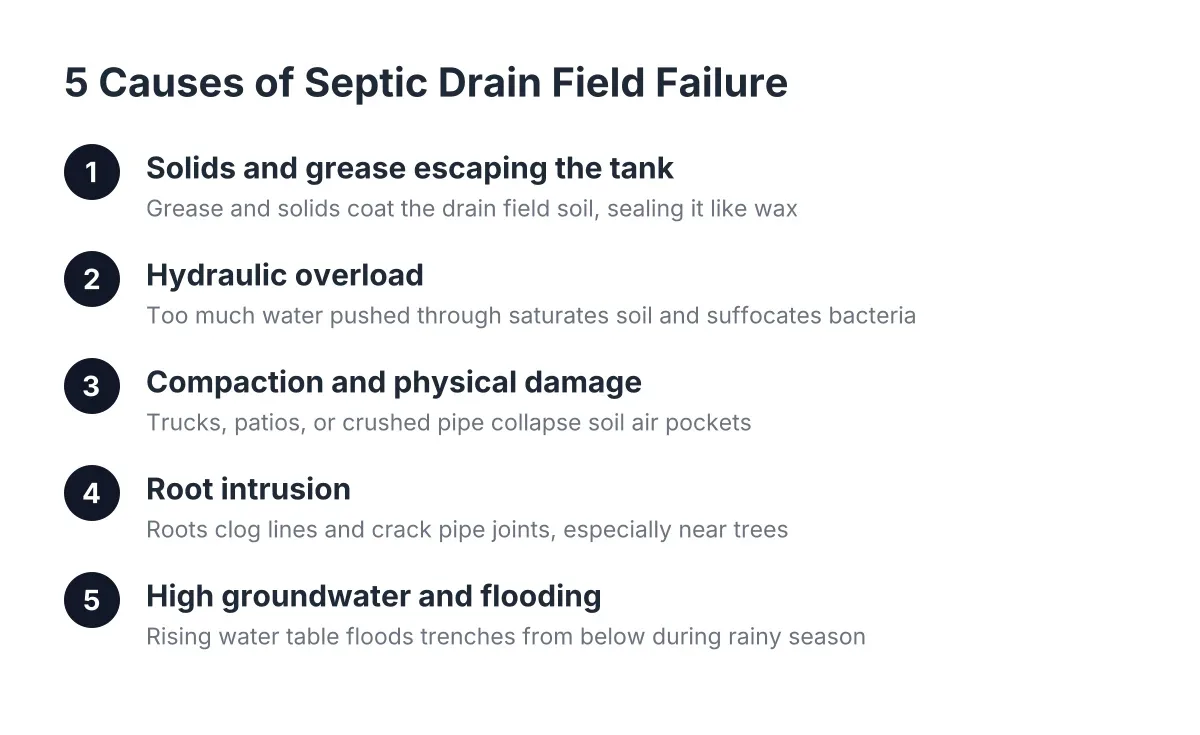
With trenches open, the failed materials come out: clogged perforated pipe, fouled gravel, and any root-invaded sections. Once a field clogs from grease, solids, or non-degradable waste, the fix is replacing the lines, not just pumping the tank again. Pumping alone cannot clean soil.
The rebuild follows a proven layered design. According to the US EPA, a drain field is built by laying a thick layer of gravel, placing perforated drain pipes on top, covering the pipes with more gravel, and burying the whole assembly with soil. Wastewater then filters through gravel or stone, and finally through sand and native soil layers. Some Miami-area systems use leach chambers set in a sand bed instead of pipe and gravel; the principle is the same, spreading effluent so soil can treat it.
Before backfill, an inspector typically checks the open trenches against the approved design. Do not let anyone bury the work before that sign-off happens.
Step 6: Backfill and Restore the Soil During the Leach Field Repair Process
Backfilling sounds simple, but it decides how the yard recovers. The crew covers the gravel with a barrier layer or fabric to keep soil out of the stone, then backfills with the excavated soil, mounding it slightly to allow for settling. Heavy compaction over the field is off limits; compacted soil absorbs less, and the field needs every bit of absorption it can get.
Finally, the surface gets graded so rainwater sheds away from the field rather than pooling on it. Grass goes back on top, and grass only. Trees and shrubs send roots straight into new lines. Keep vehicles, sheds, and pool equipment off the field permanently. In flat, rain-heavy Miami, FL yards, that surface grading does real work every storm season.
Expect the lawn to look patchy for a season. That is the honest trade-off of a proper repair; the field underneath matters more than the grass on top.
What the Leach Field Repair Process Costs and How Long It Takes
The full leach field repair process, from diagnosis through soil restoration, typically runs from about a week to a few weeks including permitting, with the excavation itself taking days, not weeks. Cost depends on scope. As an illustrative range, repairing one failed trench or a distribution box might cost in the low thousands, while a full field replacement can reach the $5,000 to $15,000 failure range the EPA cites. Site access, water table, and required design changes move the number.
For example, say a Key Biscayne homeowner gets three quotes for the same wet spot. One quote is for a distribution box fix and partial line replacement; another is for full replacement with a new perc test and engineering. Both can be legitimate. The right one depends on what the exposed lines showed in Step 1, which is why you want that diagnosis in writing before you sign anything.
Move fast once symptoms appear. A struggling field left alone becomes a failed field, and delays turn a contained problem into wastewater surfacing in the yard, which is a health risk on top of a bigger bill. A conventional tank removes only about 30 percent of the nitrogen flowing into it, according to University of Florida IFAS, so a failing field also pushes more pollution into the surrounding soil.
How to Avoid Repeating This Repair
The cheapest leach field repair is the one you never need again. The EPA recommends inspecting the whole septic system every 1 to 3 years and pumping the tank every 3 to 5 years. On a Miami-area schedule, that looks like:
- Book a septic tank pump out every 3 to 5 years, sooner for big households or garbage disposal use.
- Have the septic tank filter cleaned at every pump out; a clogged filter is cheap insurance for the field.
- Keep grease out of drains, and schedule grease trap clean outs if you run a business kitchen.
- Never flush wipes, even "flushable" ones; they are a leading cause of clogged lines.
- Keep roof runoff, sprinklers, and vehicles off the field.
One last note on finding help. Skip national directories and generic drain cleaning companies near me results that route your call out of state. A local Miami-area septic outfit that handles pumping, tank cleaning, filter cleaning, and field work can see your whole system, keep records between visits, and tell you honestly whether a wet spot needs a pump out or a repair crew. That relationship, checked every couple of years, is what keeps this article's subject a one-time read instead of a recurring bill.
If you need septic tank pumping, Miami Septic Tanks can help.
Prefer to talk it through? Call (786) 756-8032 — a quick call is usually the fastest way to get a straight answer for your situation.